Toyota Tundra VIN Decoder: How to Read Every Digit (2000–2026)
Decode any Toyota Tundra VIN yourself: WMI plant codes (5TB vs 5TF), the full 2000–2026 model-year letter table, the check digit, and why the 2022–2024 engine recall makes it worth checking yours.
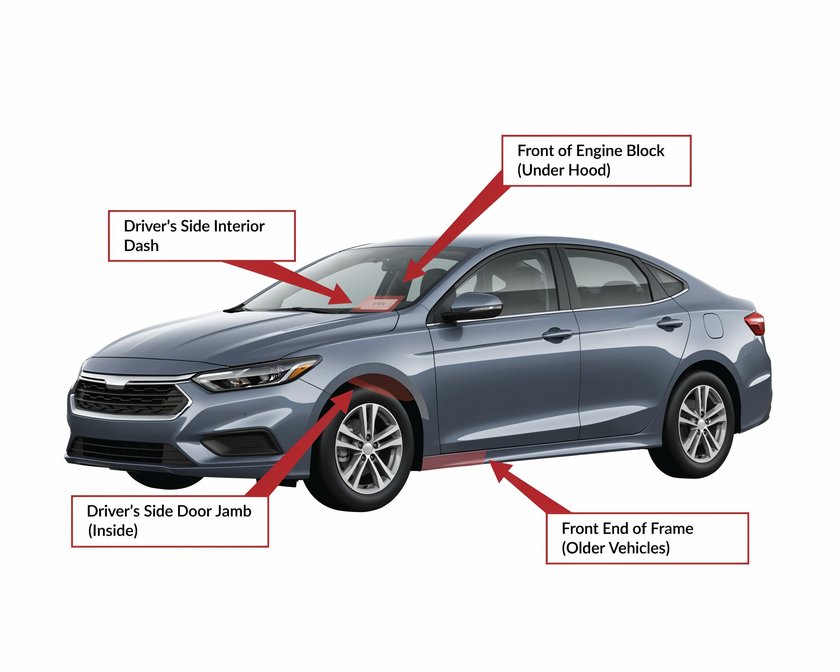
Every Toyota Tundra ever built carries a 17-character VIN that quietly answers the questions a listing photo can't: which plant built it, what year it actually is, and whether it's tangled up in an open recall. You don't need a locksmith's toolkit to read it — just a place to look and a little context on how Toyota structured the code.
This guide walks through every position of a Tundra VIN, from the plant code in the first three characters to the production sequence in the last six, and shows why running the full 17 digits matters more than eyeballing them.
Key Takeaways
- A Tundra VIN splits into five parts: WMI (1–3), Vehicle Descriptor Section (4–8), check digit (9), model year (10), plant (11), and production sequence (12–17).
- Only two WMI codes have ever applied to the Tundra: 5TB (Princeton, Indiana, 2000–2008) and 5TF (San Antonio, Texas, 2007–present) — they briefly overlapped during the 2007–2008 plant handover.
- The 10th character is a single letter or digit that maps to a model year on a repeating 30-year cycle — the same system every automaker uses.
- As of mid-2026, Toyota has issued three overlapping recalls for 2022–2024 Tundra (and related Lexus) V35A engines over manufacturing debris (Toyota Pressroom, May 2026) — a VIN-specific check is the only way to know if a given truck is affected.
- Positions 4–8 do encode body style, cab, and engine, but Toyota's exact codes shift across generations — a full decode needs our NHTSA-backed VIN lookup tool, not a static chart.
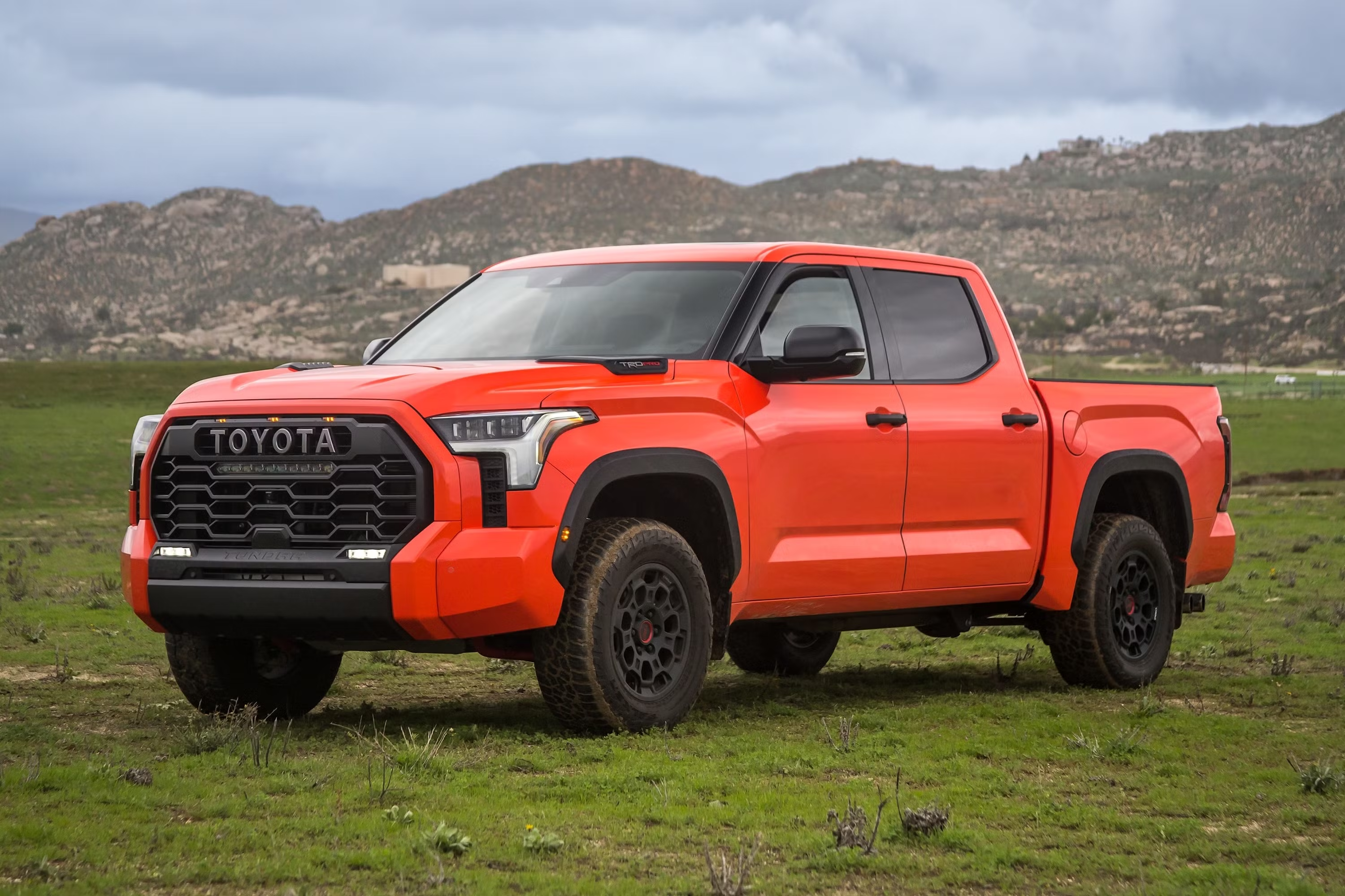
Where to Find the VIN on a Toyota Tundra
Before decoding anything, confirm you're reading the VIN itself and not a parts or engine number. On every Tundra generation, the VIN appears in three places:
- Windshield: a metal plate visible through the lower corner of the driver-side windshield, read from outside the truck.
- Door jamb: a sticker on the driver-side door frame, alongside the tire-pressure and paint-code labels.
- Frame stamp: the VIN is also stamped into the front frame rail, near the front suspension — useful for confirming a title after body or frame work.
All three should match exactly. If they don't, that's a bigger red flag than anything a VIN decoder alone will tell you.
Toyota Tundra VIN Structure at a Glance
A Tundra VIN — like every U.S.-market vehicle VIN since 1981 — follows the same ISO 3779 / NHTSA layout, just with Toyota's own values filled in:
| Positions | Section | What It Tells You |
|---|---|---|
| 1–3 | World Manufacturer Identifier (WMI) | Country and manufacturing plant |
| 4–8 | Vehicle Descriptor Section (VDS) | Model line, cab/body style, engine, restraint system |
| 9 | Check digit | Confirms the VIN was transcribed correctly |
| 10 | Model year | The vehicle's model year, as a single character |
| 11 | Plant code | The specific assembly line within the WMI's plant |
| 12–17 | Production sequence | A running serial number for that plant and year |
Here's what that looks like mapped onto a real-format example VIN:
Positions 1–3: World Manufacturer Identifier (WMI)
Unlike Toyota's passenger cars, which have been built across Japan, Kentucky, Canada, and Mexico, the Tundra has only ever come from two plants in the United States:
| WMI | Plant | Model Years | Notes |
|---|---|---|---|
| 5TB | Toyota Motor Manufacturing, Indiana (Princeton, IN) | 2000–2008 | Original Tundra plant; wound down as production shifted to Texas |
| 5TF | Toyota Motor Manufacturing, Texas (San Antonio, TX) | 2007–present | Sole Tundra plant since 2009; also builds the Tacoma (bumper.com, VIN decoder data) |
The two codes overlap for 2007–2008 because Toyota ran both plants simultaneously during the second-generation launch, before consolidating all Tundra production in San Antonio. If you see a Tundra VIN starting with anything other than 5TB or 5TF, treat that as a strong signal to double-check the VIN was transcribed correctly before trusting the rest of the decode.
Positions 4–8: Vehicle Descriptor Section (VDS)
This block is where cab configuration (Regular, Double/Access, or CrewMax), bed length, engine, and restraint system are encoded. It's also the least static part of the VIN — Toyota has reused and reassigned VDS characters across the Tundra's three generations as trims, engines, and safety equipment changed.
That's the honest limitation of any static VIN chart: a single-letter reference table for positions 4–8 that's accurate for a 2009 Tundra won't necessarily hold for a 2023 model. For a reliable read on cab, engine, or trim from the VIN alone, run it through our free Tundra VIN lookup, which pulls the current NHTSA vPIC dataset instead of a fixed table.
Position 9: The Check Digit
The ninth character isn't descriptive — it's a built-in error check. The other 16 characters are each converted to a number using a standard NHTSA/SAE transliteration table, multiplied by a fixed weight tied to their position, summed, and reduced modulo 11. The result should match the check digit exactly (a result of 10 becomes the letter X).
In practice, this means position 9 tells you nothing about the truck itself — but if a decoder flags a VIN as invalid, it's almost always because a character was misread (0 vs. O, 1 vs. I, 5 vs. S are the usual suspects), not because the truck is fake.
Position 10: Model Year Code
Toyota uses the same universal model-year cycle as every other manufacturer selling in the U.S.: a fixed sequence of letters and digits that repeats every 30 years, skipping I, O, Q, U, Z, and 0 to avoid confusion with similar-looking characters.
| Code | Model Year | Code | Model Year |
|---|---|---|---|
| Y | 2000 | H | 2017 |
| 1 | 2001 | J | 2018 |
| 2 | 2002 | K | 2019 |
| 3 | 2003 | L | 2020 |
| 4 | 2004 | M | 2021 |
| 5 | 2005 | N | 2022 |
| 6 | 2006 | P | 2023 |
| 7 | 2007 | R | 2024 |
| 8 | 2008 | S | 2025 |
| 9 | 2009 | T | 2026 |
| A | 2010 | ||
| B | 2011 | ||
| C | 2012 | ||
| D | 2013 | ||
| E | 2014 | ||
| F | 2015 | ||
| G | 2016 |
This same letter can mean a different year for a car built decades apart (the cycle repeats), but since the Tundra has only existed since 2000, there's no ambiguity yet — each code above maps to exactly one Tundra model year.
Position 11: Assembly Plant
Position 11 narrows things down further than the WMI alone — within a plant, it identifies the specific assembly line the truck came down. Because Toyota's plant-code assignments have shifted as San Antonio's TMMTX facility expanded (it now also builds the Tacoma), the safest way to confirm an exact line is to cross-reference position 11 against the current NHTSA vPIC database rather than a fixed letter chart, which is exactly what an automated decoder does for you.
Positions 12–17: Production Sequence
The last six characters are a running serial number, reset each model year at each plant. On their own they're meaningless — but combined with the WMI and model year, they confirm internal consistency. A VIN where the serial number falls outside the range Toyota is known to have produced for that plant and year is worth a second look before you rely on anything else the seller has told you.
Toyota Tundra Generations by VIN and Engine
Knowing which generation a VIN belongs to helps you sanity-check everything else on the listing — engine, towing capacity, and available safety tech all shifted at each redesign.
Why Decode Your Tundra's VIN?
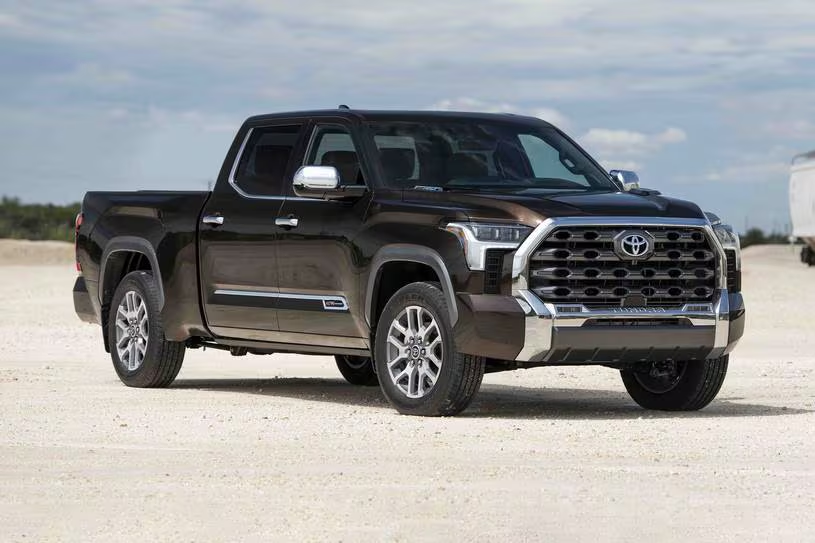
A VIN decode is more than trivia once you're looking at a specific truck to buy, insure, or repair. The clearest current example: Toyota has been working through a multi-year recall on the V35A 3.4-liter twin-turbo V6 used in 2022–2024 Tundra (and related Lexus LX/GX models), after finding that manufacturing debris left in the engine can damage the main bearing and cause a loss of drive power (Toyota Pressroom, May 2026).
The recall has expanded three times — May 2024, November 2025, and again in May 2026 — as Toyota's inspection net widened, and a June 2025 NHTSA campaign alone covered 126,691 vehicles across Tundra, LX, and GX (NHTSA Campaign 25V767000). None of that shows up by looking at a truck; it shows up by running the VIN against NHTSA's recall database. If you're evaluating a 2022–2024 Tundra with the 3.4L twin-turbo, that's a five-minute check worth doing before anything else.
How to Verify a Tundra's Full History Beyond the VIN Decoder
A structural VIN decode tells you what Toyota built. It won't tell you about accident history, title branding, odometer rollbacks, or how many owners a specific truck has had. For that, you need a full vehicle history report pulled against the actual VIN — not a lookup table. Running a full Tundra history report combines the NHTSA structural decode with title and accident record data so you're not relying on a seller's word for either half of the picture.
The Bottom Line
A Tundra VIN packs country, plant, model year, and a production fingerprint into 17 characters — and every position past the WMI and check digit gets more useful when it's checked against Toyota's actual production data instead of a static chart, especially for a truck old enough to have moved plants once already and new enough to be caught in an active engine recall. Read the plate, cross-check the WMI and year yourself, and run the full VIN through a proper decoder before it's the only thing standing between you and a truck with an open recall.
Decode Your Tundra VIN
Instant results. No signup required.
Pull the real history behind any car — recalls, title brands, odometer trail.
Our Services
Generate and print an authentic window sticker for any Toyota vehicle using its VIN.
Obtain a comprehensive factory build sheet detailing all specifications for any Toyota using its VIN.
Access unlimited vehicle history reports and detailed information for Toyota dealerships.
Find the exact paint code and color details for a Toyota by VIN.
Look up factory-installed options and packages for any Toyota by VIN.
Check the warranty status and coverage details of a Toyota by VIN.
Retrieve detailed specifications, including engine, transmission, and dimensions, for any Toyota by VIN.
Frequently Asked Questions
No. Tundras built from 2000–2008 at the Princeton, Indiana plant use WMI 5TB. From 2007 onward — and exclusively since 2009 — Tundras built in San Antonio, Texas use WMI 5TF. If a VIN claiming to be a Tundra doesn't start with 5TB or 5TF, verify it carefully before trusting the rest.
It's a check digit, not a description of the truck. It exists purely so a decoder (or a person) can catch a transcription error — a single mistyped character elsewhere in the VIN will usually make the check digit fail to match.
The engine and drivetrain are encoded in positions 4–8, but Toyota's specific letter assignments for those positions have changed across generations and aren't published as a single stable chart. A VIN decoder that queries NHTSA's live vPIC database is far more reliable here than any static reference table, including this one.
Start by re-reading the VIN character by character against the door-jamb sticker; the most common cause is confusing a zero with the letter O, or a one with the letter I, in position 10. If the characters check out and the year still looks wrong, the VIN itself may not belong to the vehicle it's attached to.
It doesn't. Position 10 is the only place a Tundra's model year is directly encoded in the VIN — everything else on the label (build date, production month) comes from separate compliance stickers, not the VIN itself.
Related Guides
Where Are Toyota Tundras Made? Tundra Manufacturing Locations | Toyota Vin Decoder
Find out where Toyota Tundras are made. Learn about the Tundra's manufacturing plants, production history, and its American-made roots. Get your VIN report now!
What Does LE Stand For Toyota? Trim Level Guide & VIN Decoder
Uncover the meaning of Toyota LE trim levels. Discover features, compare trims, and decode your VIN. Learn about SE, XLE, and more. Get the details here!
Toyota Transmission Fluid Change: Timing, Cost & Instructions
Need to change your Toyota transmission fluid? Find out how often, what it costs, and how to do it. Get the best advice and keep your Toyota running smoothly.
Grinding Noise When Accelerating: Causes & Solutions | Toyota VIN Decoder
Experiencing a grinding noise when accelerating? This guide explains common causes like wheel bearings, brakes, and more. Get expert advice and solutions for your car.
Bank 1 Sensor 2 Upstream or Downstream? Location & Function
Demystifying Bank 1 Sensor 2. Is it upstream or downstream? Find out the exact location, what it does, and how to troubleshoot problems. Get insights and resources for your Toyota at ToyotaVinDecoder.com.

Modded Toyota Camry: Customization, Mods, and Styling Guide
Discover the best modded Toyota Camry ideas! Learn about performance upgrades, styling, and customization. Find inspiration for your own Camry mods.
Decode Your Toyota VIN Free
Get instant results. No signup required.