Toyota Highlander VIN Decoder: How to Read Every Character
Decode any Toyota Highlander VIN yourself — full character breakdown, WMI codes, model-year chart, and generation/engine table.
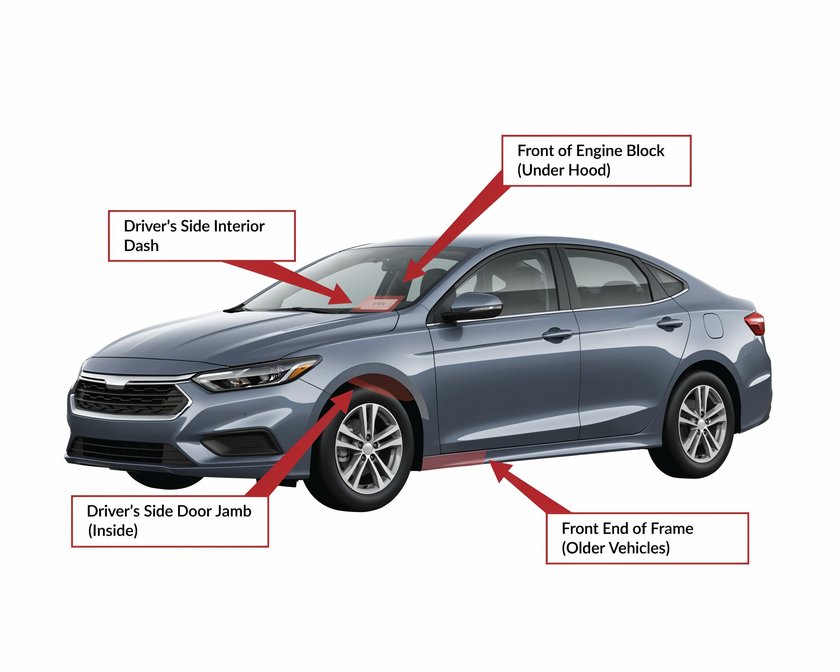
Every Toyota Highlander carries a 17-character code that quietly holds its entire factory identity — model year, engine, drivetrain, trim family, and the plant that built it. Whether you're checking a used listing, confirming your own SUV's spec sheet, or just curious what those characters mean, you don't need a paid report to read the basics. This guide breaks down the Highlander's VIN position by position, using Toyota's own coding conventions and the federal VIN standard every automaker follows.
Key Takeaways
- Positions 1–3 (the WMI) tell you the country and plant family; nearly every North American Highlander starts with JTE (2001–2013) or 5TD (2010–present).
- Position 10 is the model year — a single letter or digit you can read straight off a chart, no calculator needed.
- Almost every U.S.-market Highlander since October 2000 has come from one plant: Toyota Motor Manufacturing Indiana (TMMI) in Princeton, Indiana.
- The gas engine changed from a 3.5L V6 to a 2.4L turbo four-cylinder starting with the 2023 model year — a detail worth checking against any listing that predates the switch.
- You can decode the full VIN — including open recalls — with the free tool on this page; the sections below just explain what it's actually reading.
Where to Find the VIN on a Toyota Highlander
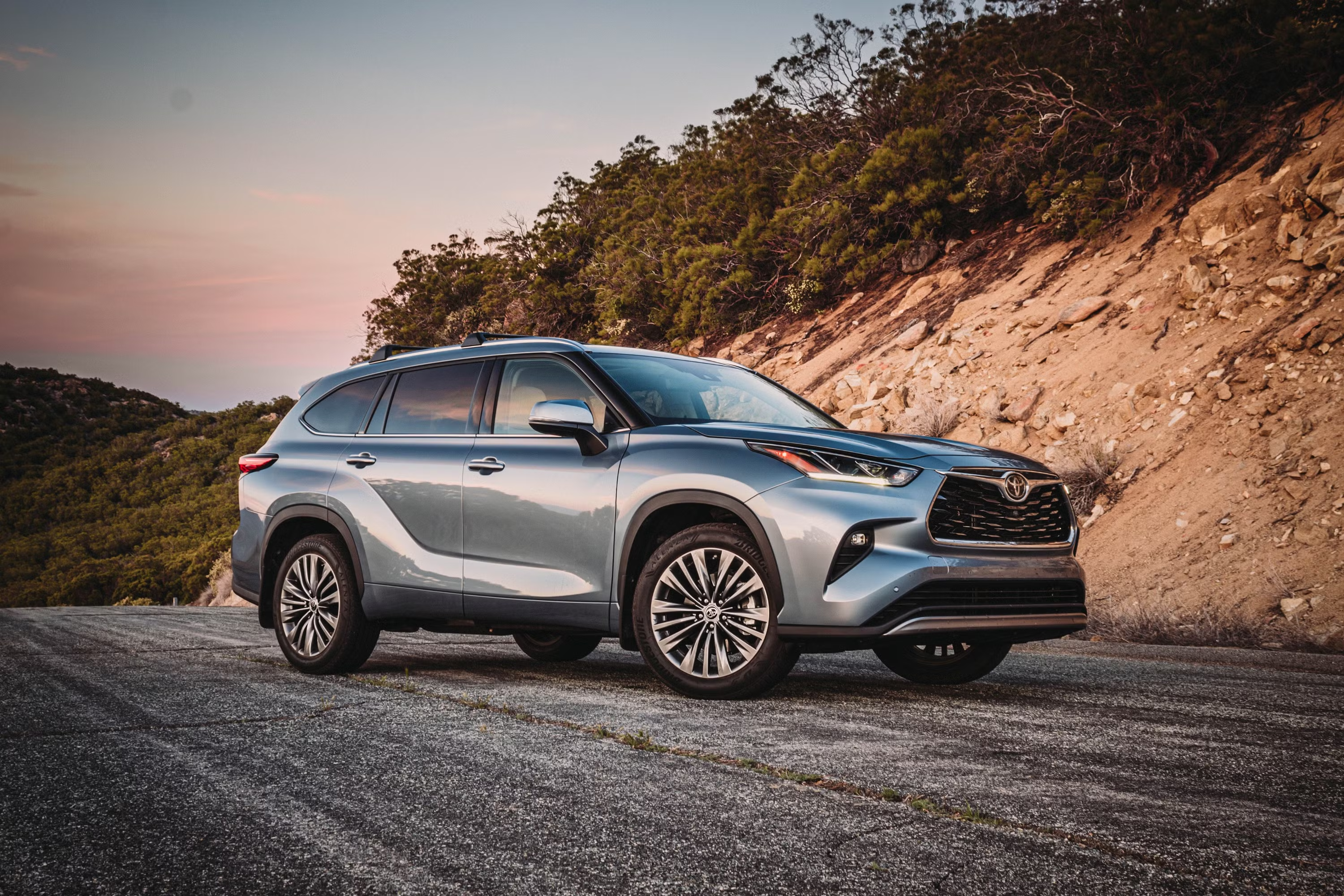
Before you can decode anything, you need a clean read of all 17 characters. On a Highlander, the VIN appears in the same handful of spots across every generation:
- Driver's-side dashboard, visible through the lower corner of the windshield from outside the car — the fastest way to check a vehicle in a parking lot
- Driver's door jamb sticker, on the pillar where the door latches shut, alongside the tire pressure and paint code
- Title, registration, and insurance card
- Engine bay, stamped on the frame near the firewall (varies by generation)
- Toyota Connected Services / Multimedia menu, on 2020-and-newer (XU70) models with the built-in infotainment system
The Full VIN Layout: What Each of the 17 Characters Means
Every Highlander VIN — like every VIN sold in the U.S. since 1981 — follows the same federal structure (49 CFR Part 565), built on three sections:
| Positions | Section | What it tells you |
|---|---|---|
| 1–3 | World Manufacturer Identifier (WMI) | Country of assembly and manufacturer |
| 4–8 | Vehicle Descriptor Section (VDS) | Model, body style, restraint system, engine, and grade — Toyota-specific coding |
| 9 | Check digit | A calculated value that validates the other 16 characters are legitimate |
| 10 | Model year | A single letter or digit on a repeating 30-year cycle |
| 11 | Assembly plant | The specific factory that built the vehicle |
| 12–17 | Production sequence number | The unique serial number for that individual Highlander |
The diagram below applies that same structure to one illustrative example VIN, color-coded by section:
The first two sections are where the Highlander-specific detail lives, so let's go through them in order.
Characters 1–3: The WMI (Manufacturer and Country)
Toyota has used two main WMIs for U.S.-market Highlanders over the years:
| WMI | Manufacturer | Model years | Vehicle type |
|---|---|---|---|
| JTE | Toyota Motor Corporation | 2001–2013 | Multipurpose Passenger Vehicle (MPV) |
| 5TD | Toyota Motor Manufacturing, Indiana (TMMI) | 2010–present | Multipurpose Passenger Vehicle (MPV) |
Both codes point to the same vehicle line — the overlap between 2010 and 2013 reflects Toyota consolidating Highlander production entirely into the Princeton, Indiana plant, a process that finished by 2013 (more on that below). A VIN starting with 4T3 or a similar Toyota WMI on other models refers to a different vehicle line entirely, so if a "Highlander" listing shows an unfamiliar WMI, it's worth running it through a full decoder before trusting the listing.
Characters 4–8: Body, Engine, and Trim (VDS)
This is Toyota's own coding block, and it's where the VIN gets genuinely useful for buyers. Depending on model year, these five characters typically encode:
- Body style and restraint system (airbag configuration)
- Engine displacement and cylinder count
- Drive type (FWD vs. AWD) and transmission
- Trim/grade level within the Highlander lineup
Because Toyota reuses similar character patterns across models, this section is the hardest to read manually and the easiest to get wrong by eyeballing it — it's exactly what a decoder tool is for. As one general reference point: a Highlander VIN with a "4-cylinder, 2.7L, 185 hp" reading in this block indicates a base-trim FWD model from the XU50 generation (2014–2019), since that engine wasn't offered on later or earlier Highlanders in that configuration.
Character 9: The Check Digit
The ninth character isn't descriptive — it's a math check. It's calculated from the other 16 characters using a fixed formula: each character is converted to a numeric value (letters map to 1–9 on a repeating scale; digits keep their own value), multiplied by a weight assigned to its position, and the results are summed and divided by 11. The remainder becomes the check digit — a number 0–9, or the letter X if the remainder is 10.
| Position | 1 | 2 | 3 | 4 | 5 | 6 | 7 | 8 | 9 | 10 | 11 | 12 | 13 | 14 | 15 | 16 | 17 |
|---|---|---|---|---|---|---|---|---|---|---|---|---|---|---|---|---|---|
| Weight | 8 | 7 | 6 | 5 | 4 | 3 | 2 | 10 | — | 9 | 8 | 7 | 6 | 5 | 4 | 3 | 2 |
You'll never need to calculate this by hand — every legitimate VIN decoder (including the one on this page) checks it automatically, and a mismatch is one of the fastest ways to catch a mistyped or altered VIN before you rely on it.
Character 10: Model Year
This is the one most people actually want. It follows the same 30-year cycle every manufacturer uses, skipping the letters I, O, Q, U, and Z to avoid confusion with numbers:
| Code | Year |
|---|---|
| 1 | 2001 |
| 2 | 2002 |
| 3 | 2003 |
| 4 | 2004 |
| 5 | 2005 |
| 6 | 2006 |
| 7 | 2007 |
| 8 | 2008 |
| 9 | 2009 |
| A | 2010 |
| B | 2011 |
| C | 2012 |
| D | 2013 |
| E | 2014 |
| F | 2015 |
| G | 2016 |
| H | 2017 |
| J | 2018 |
| K | 2019 |
| L | 2020 |
| M | 2021 |
| N | 2022 |
| P | 2023 |
| R | 2024 |
| S | 2025 |
| T | 2026 |
Character 11: Assembly Plant
This is where the Highlander's story gets more specific than most SUVs on the road. With very few exceptions, every U.S.-market Highlander since production began has come from a single factory:
Toyota Motor Manufacturing Indiana (TMMI), Princeton, Indiana.
Production started there on October 8, 2000, as Toyota's 12th North American-built model. Early Highlander Hybrids were briefly sourced from Toyota's Kyushu, Japan plant before Toyota localized hybrid production to Princeton in 2013, and non-hybrid Highlander assembly was fully consolidated to Indiana that same year. Today TMMI builds the Highlander, Highlander Hybrid, and Sienna, with the capacity to assemble more than 400,000 vehicles a year. This is genuinely useful for verification purposes: a Highlander VIN whose plant character doesn't map to Princeton (outside of that early hybrid window) is worth a second look.
Toyota Highlander Generations, by VIN
Cross-referencing the model-year character against the generation below tells you the platform, and roughly which engines the VDS block should be describing:
| Generation | Chassis code | Model years | Engine options | Where built |
|---|---|---|---|---|
| 1st gen | XU20 | 2001–2007 | 2.4L I4; 3.0L V6 (2001–03); 3.3L V6 (2004–07) | Princeton, IN (U.S. market) |
| 2nd gen | XU40 | 2008–2013 | 2.7L I4; 3.5L V6; V6 Hybrid | Princeton, IN |
| 3rd gen | XU50 | 2014–2019 | 2.7L I4 (2014–16); 3.5L V6; 3.5L V6 Hybrid | Princeton, IN |
| 4th gen | XU70 | 2020–present | 3.5L V6 (2020–22); 2.4L turbo I4 (2023–present); 2.5L I4 Hybrid | Princeton, IN |
Here's how those four generations line up on a timeline:
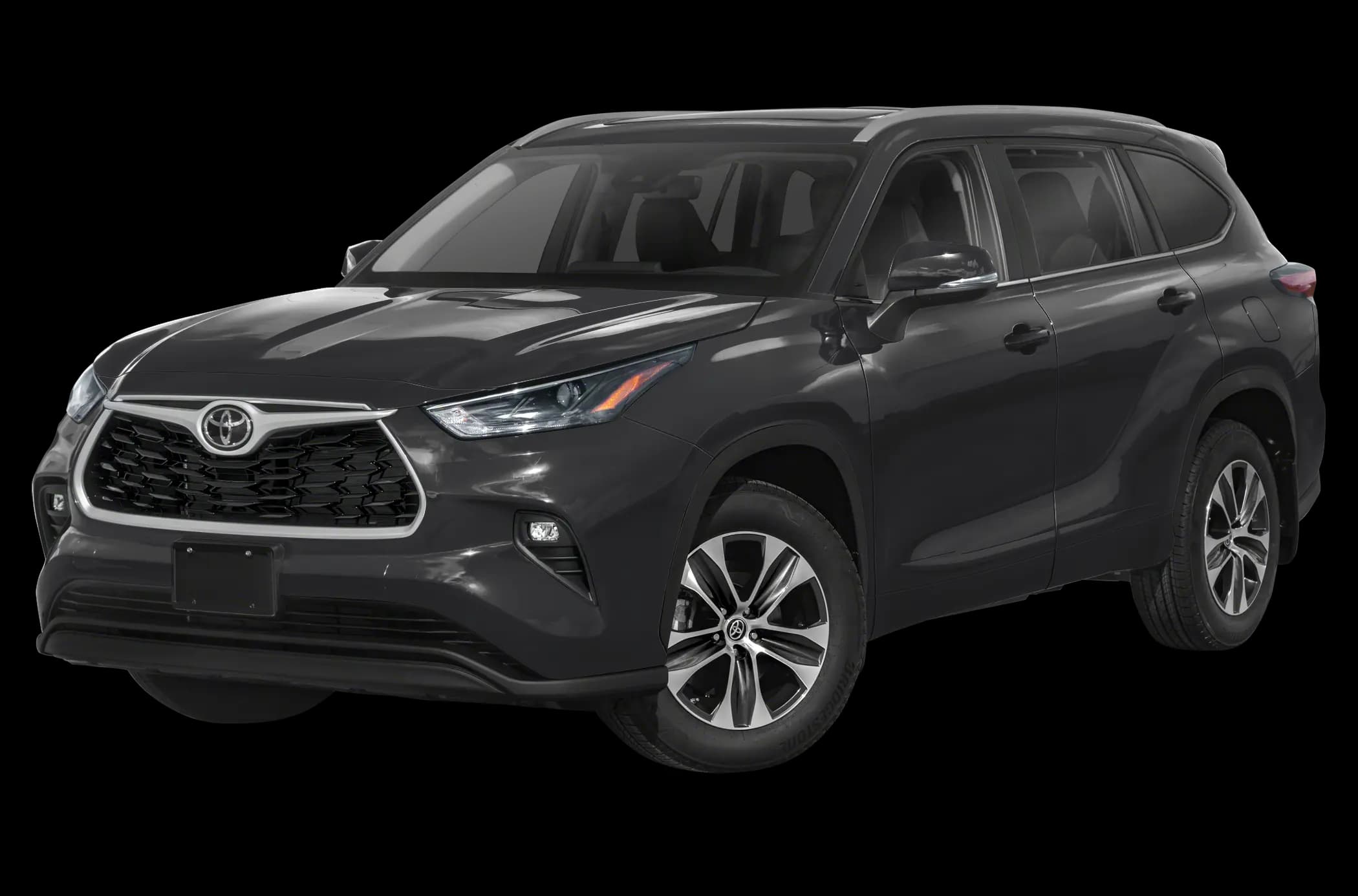
The 2023 switch from the naturally aspirated 3.5L V6 to a 2.4L turbocharged four-cylinder is the biggest recent powertrain change: the new engine trades a modest 30 hp for a 17% torque increase, while cutting NOx and NMOG emissions by roughly half. It's a good example of why matching the VIN's model year and engine code to a listing's description matters — a private-party ad that says "V6" on a 2023-or-newer Highlander is worth double-checking. For 2026, the Highlander carries over largely unchanged from 2025, with Toyota trimming the hybrid lineup down to fewer trim choices rather than introducing a new generation.
One related mix-up worth flagging: the Toyota Grand Highlander, a longer three-row SUV launched for 2024, is a separate model built on a related but distinct platform — it shares WMI patterns with the Highlander but decodes to its own VDS values, so don't assume the two are interchangeable when reading a VIN.
Cross-shopping the two? See our Highlander vs. Grand Highlander comparison.
Characters 12–17: Production Sequence Number
The final six characters are the individual serial number assigned on the assembly line — unique to that specific Highlander, with no encoded meaning beyond identifying one vehicle from the next in the same plant and model year.
Why Decoding the VIN Matters Before You Buy
A quick decode does more than satisfy curiosity — it's a practical check against a few common problems in the used-SUV market:
- Confirms the actual spec. Engine, drivetrain, and trim from the VIN should match what the seller advertises.
- Surfaces open recalls. NHTSA ties recall campaigns to specific VIN ranges, so a decode can flag unresolved safety work before you buy.
- Flags plant/year mismatches. A VIN whose model year, WMI, or plant code don't line up with each other is a red flag worth investigating further.
- Helps with insurance and registration. Confirming trim and engine details up front avoids paperwork headaches later.
Check this Highlander's VIN for open recalls before you finalize the purchase.
Decode Your Toyota Highlander VIN Free
Instant results. No signup required.
Decode Your Toyota VIN
Pull the real history behind any car — recalls, title brands, odometer trail.
Our Services
Generate and print an authentic window sticker for any Toyota vehicle using its VIN.
Obtain a comprehensive factory build sheet detailing all specifications for any Toyota using its VIN.
Access unlimited vehicle history reports and detailed information for Toyota dealerships.
Find the exact paint code and color details for a Toyota by VIN.
Look up factory-installed options and packages for any Toyota by VIN.
Check the warranty status and coverage details of a Toyota by VIN.
Retrieve detailed specifications, including engine, transmission, and dimensions, for any Toyota by VIN.
Frequently Asked Questions
Check the driver's-side dashboard (visible through the windshield), the door jamb sticker on the driver's door pillar, or your title, registration, and insurance documents.
It's the model year, encoded as a single digit or letter on a repeating 30-year cycle — for example, T marks a 2026 Highlander and S marks 2025.
Both are legitimate Toyota WMIs for the Highlander. JTE was used from 2001–2013; 5TD has been used since 2010, once Toyota fully consolidated Highlander assembly at its Princeton, Indiana plant.
Yes — the engine and powertrain details live in the Vehicle Descriptor Section (characters 4–8), which a full decode will translate into the actual engine size and hybrid status rather than requiring you to read the raw characters yourself.
Yes. The decoder on this page pulls directly from NHTSA's vPIC database — the same source manufacturers report to — at no cost, and includes open recalls alongside the basic decode.
Related Guides
Where Are Toyota Tundras Made? Tundra Manufacturing Locations | Toyota Vin Decoder
Find out where Toyota Tundras are made. Learn about the Tundra's manufacturing plants, production history, and its American-made roots. Get your VIN report now!
What Does LE Stand For Toyota? Trim Level Guide & VIN Decoder
Uncover the meaning of Toyota LE trim levels. Discover features, compare trims, and decode your VIN. Learn about SE, XLE, and more. Get the details here!
Toyota Transmission Fluid Change: Timing, Cost & Instructions
Need to change your Toyota transmission fluid? Find out how often, what it costs, and how to do it. Get the best advice and keep your Toyota running smoothly.
Grinding Noise When Accelerating: Causes & Solutions | Toyota VIN Decoder
Experiencing a grinding noise when accelerating? This guide explains common causes like wheel bearings, brakes, and more. Get expert advice and solutions for your car.
Bank 1 Sensor 2 Upstream or Downstream? Location & Function
Demystifying Bank 1 Sensor 2. Is it upstream or downstream? Find out the exact location, what it does, and how to troubleshoot problems. Get insights and resources for your Toyota at ToyotaVinDecoder.com.

Modded Toyota Camry: Customization, Mods, and Styling Guide
Discover the best modded Toyota Camry ideas! Learn about performance upgrades, styling, and customization. Find inspiration for your own Camry mods.
Decode Your Toyota VIN Free
Get instant results. No signup required.