Toyota 4Runner VIN Decoder: How to Read Every Character
WMI, model year, plant code, and generation — plus how to spot odometer and title fraud before you buy.

Every Toyota 4Runner carries a 17-character fingerprint stamped into its dashboard, door jamb, and frame — its Vehicle Identification Number. Read it correctly and it tells you the model year, the factory that built the SUV, and which of the 4Runner's six generations you're looking at, before you check a single maintenance record.
That's worth doing before you rely on anything else the seller tells you. CARFAX reported in mid-December 2025 that roughly 2.45 million vehicles on US roads are suspected of having a rolled-back odometer, a 14 percent jump from the year before (CARFAX, Dec. 2025, retrieved 2026-09-05). Decoding a VIN won't catch a rolled-back odometer on its own, but it's the free first step every paid vehicle history report is built on — and it's the fastest way to confirm a 4Runner is actually the year, trim, and origin the listing claims.
This guide walks the 4Runner's VIN structure position by position using a real example, gives you a generation-by-VIN lookup table, and lists the free tools worth running before you put down a deposit. For the mechanics of VIN decoding in general, see [INTERNAL-LINK: what a VIN is and how decoding works — general VIN decoder guide].
Key Takeaways
- Every 4Runner VIN follows the same 17-character layout the industry has used since 1981: manufacturer code, vehicle description, check digit, model year, plant, and serial number.
- The 4Runner's World Manufacturer Identifier was JT3 through the early 2000s and has been JTE since the 2003 model year — including the redesigned 2025-2026 sixth generation.
- The 10th character reveals model year on a rotating cycle: "S" means 2025 and "T" means 2026, the two most recent 4Runner model years.
- A VIN decode confirms factory specs. It won't show accidents, rolled-back mileage, or a washed title — that takes a full vehicle history report, plus free tools like NHTSA's recall lookup and NICB's VINCheck.
What a VIN Actually Encodes
Every vehicle sold in the US since 1981 uses the same 17-character format defined by ISO 3779 and enforced by NHTSA under 49 CFR Part 565. The standard splits the VIN into three blocks: the World Manufacturer Identifier (WMI) in positions 1-3, the Vehicle Descriptor Section (VDS) in positions 4-9, and the Vehicle Identifier Section (VIS) in positions 10-17. Toyota fits the 4Runner's specifics into that shared template the same way every other manufacturer does — nothing about a 4Runner's VIN is proprietary to the format itself.
Anatomy of a Toyota 4Runner VIN
Here's a real, correctly-formed VIN from a 2025 4Runner: JTEVA5BR5S5005403. The table below breaks down what each block means for this specific truck.
| Positions | Section | This VIN |
|---|---|---|
| 1-3 | WMI | JTE — Toyota, built for the North American market |
| 4-8 | VDS | VA5BR — Toyota's internal body, engine, and trim code |
| 9 | Check digit | 5 — a math check that flags an altered or mistyped VIN |
| 10 | Model year | S — 2025 |
| 11 | Plant | 5 — Tahara, Japan |
| 12-17 | Serial number | 005403 — this truck's spot in the production sequence |
Positions 1-3: the WMI
The World Manufacturer Identifier is the clearest signal of who built the vehicle and where. For the 4Runner specifically, it has only had two values in the model's modern history: JT3 covered Japan-built 4Runners from the mid-1980s through the early 2000s, and JTE has covered every 4Runner sold in North America since the 2003 model year (Bumper, retrieved 2026-09-05). That includes the redesigned sixth generation — a real 2025-model VIN pulled from a dealer listing still opens with JTE, confirming Toyota carried the code forward rather than issuing a new one for the platform change.
[INTERNAL-LINK: run a full Toyota 4Runner VIN check — ChassisVIN's 4Runner VIN lookup tool]
Positions 4-8: the VDS
Positions 4 through 8 are Toyota's internal Vehicle Descriptor Section — they encode body style, engine, restraint system, and trim, but Toyota doesn't publish a public code-to-feature key, and the mapping shifts across model years. Rather than guess at what a specific five-character string means, run the VIN through NHTSA's free vPIC decoder, which pulls the manufacturer-submitted mapping directly and is the same source most commercial decoders build on (NHTSA vPIC, retrieved 2026-09-05).
Position 9: the check digit
A single digit here is calculated from the other 16 characters using a weighted formula NHTSA defines in 49 CFR Part 565: each character converts to a number, gets multiplied by a fixed position weight, and the total is divided by 11 — the remainder is the check digit. Run that math on JTEVA5BR5S5005403 and the remainder comes out to 5, matching what Toyota actually printed. When a VIN's check digit doesn't match what the formula produces, that's a strong signal the number was mistyped somewhere along the way, or altered.
Positions 10-11: model year and plant
The 10th character cycles through a 30-year sequence of letters and digits, skipping I, O, Q, U, Z, and the digit 0 to avoid confusion with similar-looking characters. For the years a 4Runner buyer is most likely to encounter:
| Code | Year | Code | Year | Code | Year |
|---|---|---|---|---|---|
| A | 2010 | H | 2017 | P | 2023 |
| B | 2011 | J | 2018 | R | 2024 |
| C | 2012 | K | 2019 | S | 2025 |
| D | 2013 | L | 2020 | T | 2026 |
| E | 2014 | M | 2021 | ||
| F | 2015 | N | 2022 | ||
| G | 2016 |
The 11th character identifies the assembly plant — for the 4Runner, that's almost always Tahara, Japan, the same plant Toyota has used for the model for decades and the plant confirmed for the redesigned sixth generation (Toyota Pressroom, retrieved 2026-09-05).
Positions 12-17: the serial number
The last six characters are the vehicle's production sequence number at that plant for that model year — effectively a running count. There's no encoded meaning beyond uniqueness; two 4Runners built back-to-back on the same line will differ only here.
Match Your 4Runner's VIN to a Generation
Because the model-year code repeats every 30 years, the letter or digit alone can't tell you which 4Runner generation you're looking at without context — but paired with what you already know about the truck, it narrows things down fast:
| Generation | Model Years | 10th-Character Codes |
|---|---|---|
| 1st | 1984-1989 | E, F, G, H, J, K |
| 2nd | 1990-1995 | L, M, N, P, R, S |
| 3rd | 1996-2002 | T, V, W, X, Y, 1, 2 |
| 4th | 2003-2009 | 3, 4, 5, 6, 7, 8, 9 |
| 5th | 2010-2024 | A, B, C, D, E, F, G, H, J, K, L, M, N, P, R |
| 6th | 2025-present | S, T |
Toyota's own generation history confirms the 5th-gen run lasted from 2010 through 2024 and the redesigned 6th generation began with the 2025 model year (Toyota Pressroom, retrieved 2026-09-05). Notice that "E" shows up twice — 1984 and 2014 — which is exactly why the year code alone isn't proof of generation. Cross-check it against the body style, badges, or a full decode before you trust it on its own. [INTERNAL-LINK: 4Runner generation buying guide — best and worst 4Runner model years]
The 2025-2026 Redesign, in VIN Terms
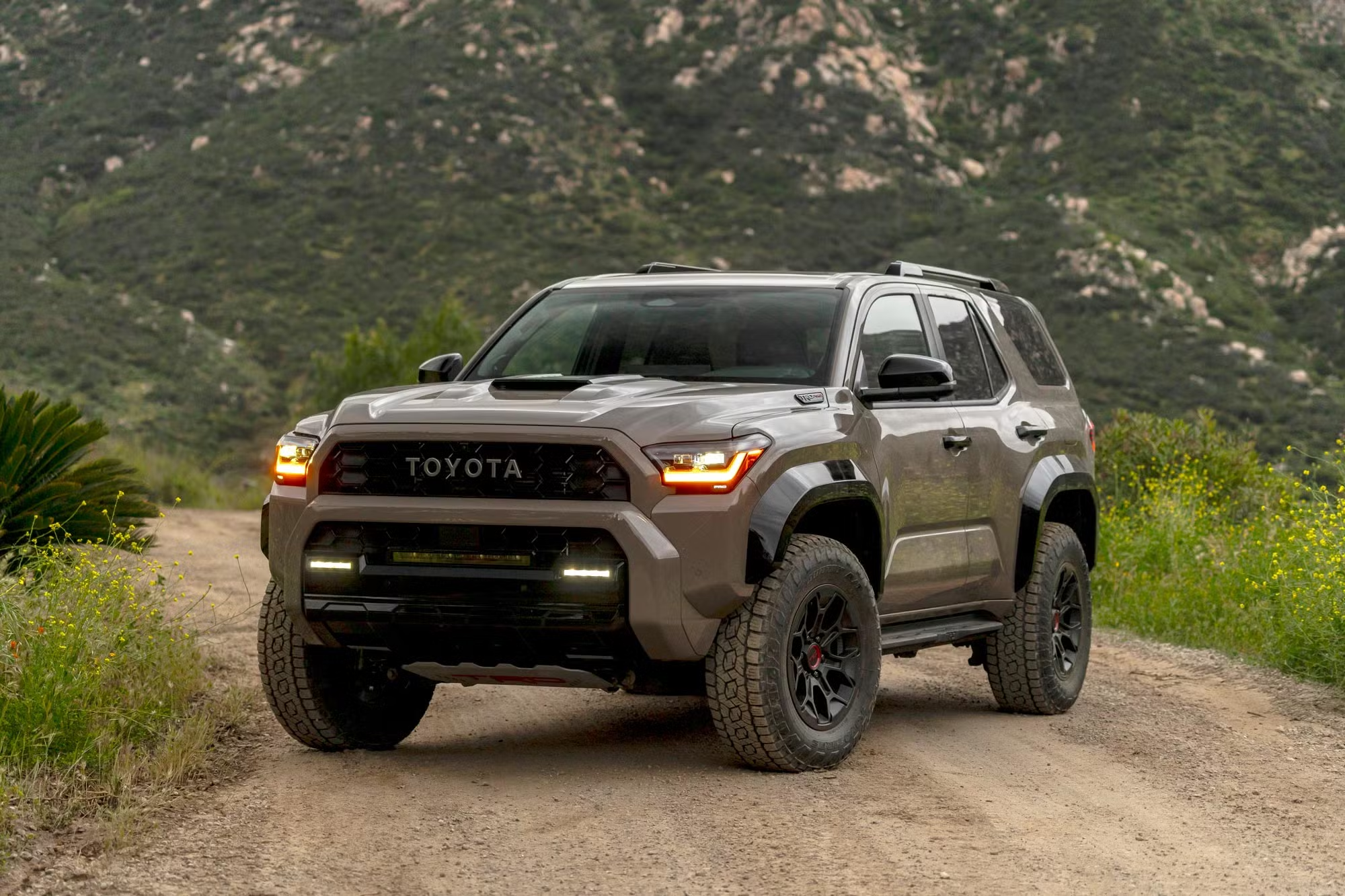
The sixth-generation 4Runner is a bigger mechanical shift than any VIN character shows on its own. It moved onto Toyota's TNGA-F body-on-frame platform, the same architecture underneath the Tacoma, Tundra, Land Cruiser, and Sequoia, replacing the previous generation's Land Cruiser Prado-based chassis (Toyota Pressroom, retrieved 2026-09-05). The standard engine became a 2.4-liter turbocharged four-cylinder rated at 278 horsepower, with an available i-FORCE MAX hybrid version — standard on TRD Pro, Trailhunter, and Platinum, optional on TRD Off-Road and Limited — producing up to 326 horsepower and 465 lb-ft of torque, all through an eight-speed automatic (Toyota Pressroom, retrieved 2026-09-05). Pricing opened at $42,220 including destination for the 2025 model year (Motor Authority, retrieved 2026-09-05).
None of that shows up directly in the VIN — you'd read it from the VDS block via a full decode, or from the trim badge and window sticker. What the VIN does confirm is origin and timing: WMI JTE, plant code 5 for Tahara, and a 10th character of S or T place a truck squarely in this redesigned generation. [INTERNAL-LINK: 2025-2026 4Runner trim comparison — trim-by-trim guide]
Why a VIN Decode Isn't the Same as a VIN Check
A decode reads what the manufacturer built. It says nothing about what happened to the truck afterward — accidents, floods, a rebuilt title, or a tampered odometer. That distinction matters more than it used to:
CARFAX's Vice President of Data Acquisition attributed the jump partly to how much easier digital odometer tampering has become as cheap tools have spread, even as more frequent digital mileage recording also makes discrepancies easier to catch after the fact (CARFAX, Dec. 2025, retrieved 2026-09-05). A year earlier, the same company had already flagged more than 2.14 million suspected rollback vehicles on US roads (CARPRO, retrieved 2026-09-05). [INTERNAL-LINK: how to spot a salvage or rebuilt title — salvage title guide]
Free Tools to Verify a 4Runner VIN
- NHTSA's vPIC decoder — free, no registration, and the source of record for factory specs since it's built from data manufacturers submit directly (NHTSA vPIC, retrieved 2026-09-05).
- NHTSA's recall lookup — enter the VIN at NHTSA.gov/recalls for any open safety recall on that specific vehicle going back at least 15 years, at no cost.
- NICB's VINCheck — free, cross-references the VIN against participating insurers' theft and salvage records, limited to five searches per 24-hour period per IP address; it only covers theft and salvage, not accidents or mileage (NICB, retrieved 2026-09-05).
- A full vehicle history report — the only way to see accident history, title brands across every state, service records, and mileage trend lines in one place. [INTERNAL-LINK: how to read a full vehicle history report — report walkthrough guide]
Common Red Flags Worth a Second Look
- VIN mismatches between the dashboard plate, the door-jamb sticker, the title, and (on older 4Runners) the frame stamp near the front wheel well.
- A check digit that doesn't compute against the formula above — most free decoders will flag this automatically.
- A year code that doesn't match the truck in front of you — an "E" 4Runner with sixth-generation styling and badging is a contradiction worth walking away from, not explaining away.
- A title issued shortly after a known flood event in a state the seller can't otherwise account for.
Bottom Line
A 4Runner's VIN takes thirty seconds to read once you know the layout: JTE for the WMI, a year code in position 10, Tahara for the plant, and a serial number that's unique to that truck. That's enough to confirm the basics match the listing. It's not enough to confirm the truck's history — for that, pair the decode with a free NICB VINCheck, a free NHTSA recall lookup, and a full vehicle history report before you sign anything. [INTERNAL-LINK: decode your Toyota 4Runner's VIN now — ChassisVIN 4Runner VIN decoder tool]
Pull the real history behind any car — recalls, title brands, odometer trail.
FAQ
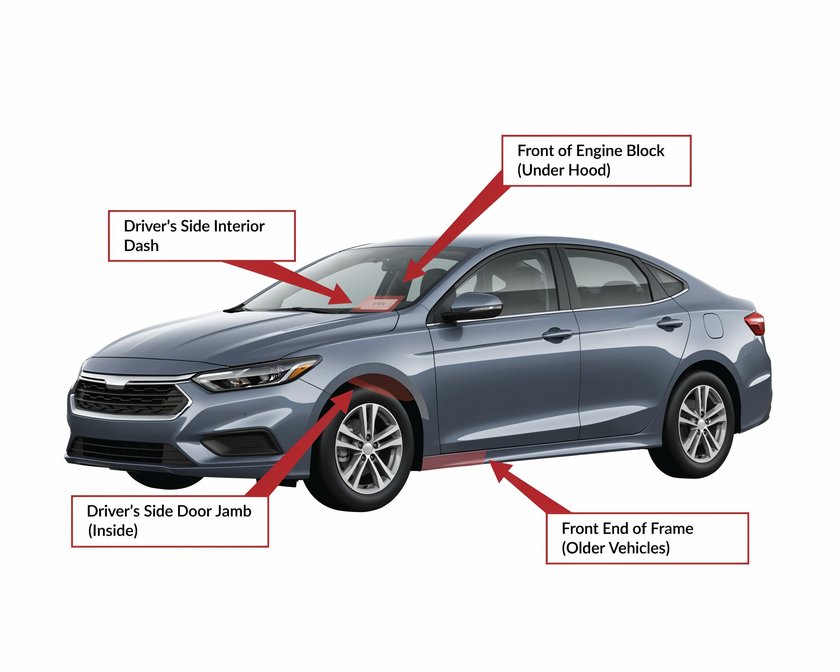
Visible through the base of the windshield on the driver's side, on a sticker inside the driver's door jamb, and — on 4th-generation and earlier trucks — stamped into the frame near the front passenger wheel well. [INTERNAL-LINK: VIN plate locations by vehicle type — VIN location guide]
Yes. Despite the platform change to TNGA-F, Toyota carried the JTE World Manufacturer Identifier forward into the sixth generation; a real 2025-model VIN pulled from a dealer listing confirms it.
No. A decode only reads factory-built specifications from the manufacturer's data. Accident history, title brands, and mileage records live in state DMV and insurance databases, which is what a full vehicle history report or NICB's VINCheck pull from instead.
Check that the VIN is physically identical on the dashboard, door jamb, title, and registration — cloned VINs are usually copied from a different, legitimately-registered vehicle to disguise a stolen or salvage one, so a mismatch anywhere is a hard stop. A check digit that fails the formula, or a decode that returns a different model or trim than the truck in front of you, are the other two most common tells.
Decoding reads what the factory built into the VIN itself — year, plant, body, engine. Checking pulls external records tied to that VIN after it left the factory — accidents, title history, theft reports, mileage readings. You want both before buying a used 4Runner, not just one.
Related Guides
Where Are Toyota Tundras Made? Tundra Manufacturing Locations | Toyota Vin Decoder
Find out where Toyota Tundras are made. Learn about the Tundra's manufacturing plants, production history, and its American-made roots. Get your VIN report now!
What Does LE Stand For Toyota? Trim Level Guide & VIN Decoder
Uncover the meaning of Toyota LE trim levels. Discover features, compare trims, and decode your VIN. Learn about SE, XLE, and more. Get the details here!
Toyota Transmission Fluid Change: Timing, Cost & Instructions
Need to change your Toyota transmission fluid? Find out how often, what it costs, and how to do it. Get the best advice and keep your Toyota running smoothly.
Grinding Noise When Accelerating: Causes & Solutions | Toyota VIN Decoder
Experiencing a grinding noise when accelerating? This guide explains common causes like wheel bearings, brakes, and more. Get expert advice and solutions for your car.
Bank 1 Sensor 2 Upstream or Downstream? Location & Function
Demystifying Bank 1 Sensor 2. Is it upstream or downstream? Find out the exact location, what it does, and how to troubleshoot problems. Get insights and resources for your Toyota at ToyotaVinDecoder.com.

Modded Toyota Camry: Customization, Mods, and Styling Guide
Discover the best modded Toyota Camry ideas! Learn about performance upgrades, styling, and customization. Find inspiration for your own Camry mods.