Toyota Tacoma VIN Decoder: How to Read Every Character
Decode any Toyota Tacoma VIN yourself — full character breakdown, WMI codes, model-year chart, and generation/plant code table.
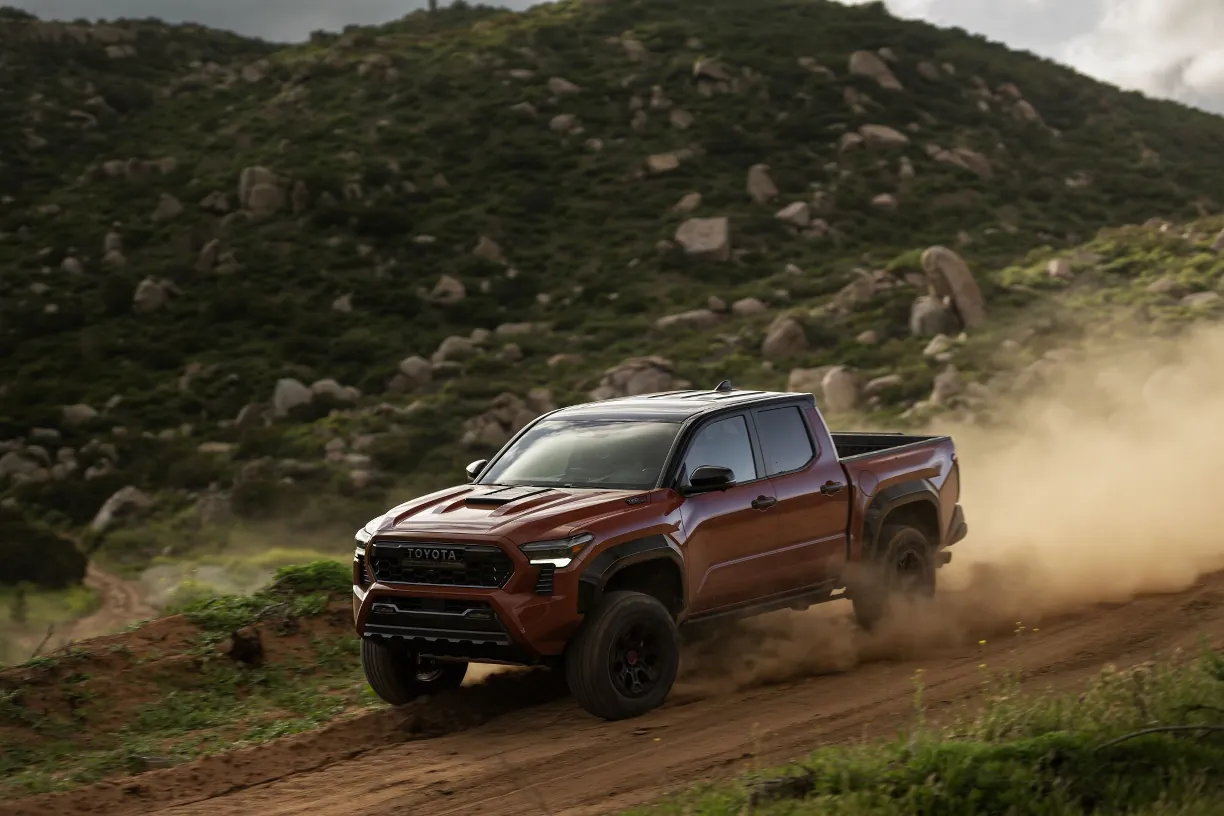
Toyota sold a record 274,638 Tacomas in 2025, more than the next three midsize-truck competitors combined — which also means more Tacomas than ever are changing hands on the used market. Whether you're buying a 2004 first-gen with a solid frame or checking a 2025 Hybrid TRD Off-Road, the 17-character VIN stamped on the truck is the fastest way to confirm what you're actually looking at: model year, assembly plant, engine, cab configuration, and whether the number matches the paperwork.
This guide breaks down every position of a Tacoma VIN, generation by generation, so you can read one yourself instead of taking a listing's word for it.
Key Takeaways
- A Tacoma VIN follows the standard 17-character U.S. format: positions 1–3 identify the manufacturer and plant region, 4–8 describe the truck's configuration, 9 is a check digit, 10 is the model year, 11 is the assembly plant, and 12–17 are the production serial number.
- The 10th character alone tells you the model year on a 30-year repeating cycle — for example, "R" means 2024, not 1994 or 1984, once you know which Tacoma generation you're looking at.
- Fourth-generation Tacomas (2024+) are built exclusively in Mexico, at either Toyota Motor Manufacturing de Baja California (plant code M) or Toyota Motor Manufacturing de Guanajuato (plant code T).
- With Tacoma sales and used-truck prices both climbing, VIN cloning and odometer rollbacks are a real risk — Carfax flagged roughly 2.45 million suspected odometer rollbacks nationwide in 2025 alone, a 14% jump from the year before.
- A dealer VIN decode is a starting point, not a guarantee — cross-check it against the door jamb sticker and a recall lookup before you buy.
How a Toyota Tacoma VIN Is Structured
Every Tacoma built since the 1995 model year carries a standardized 17-character VIN. The first nine characters and the last eight follow a federal format that's identical across manufacturers; only positions 4–8 are Toyota-defined and change meaning by model and year.
| Position | Section | What It Encodes |
|---|---|---|
| 1–3 | World Manufacturer Identifier (WMI) | Manufacturer and the region/plant family where the truck was built |
| 4–8 | Vehicle Descriptor Section (VDS) | Toyota-defined: cab style, GVWR class, engine, transmission, and drivetrain |
| 9 | Check digit | A calculated value that validates the other 16 characters |
| 10 | Model year | Encoded letter/number on a standardized 30-year cycle |
| 11 | Plant code | The specific factory that assembled the truck |
| 12–17 | Serial number | The truck's unique production sequence number |
Where Was It Built? Toyota Tacoma WMI Codes
The first three characters tell you which Toyota plant family assembled the truck. Tacoma has never been built in Japan — it's a North America-market truck through and through — so you won't see a "JT" prefix on a genuine Tacoma VIN. Instead, look for:
| WMI | Plant Family |
|---|---|
| 3TM | Toyota Motor Manufacturing de Baja California (Mexico) |
| 3TY | Toyota Motor Manufacturing de Guanajuato (Mexico) |
| 4T1 / 5TF / 5TE | Older Toyota truck WMIs used across NUMMI (Fremont, CA) and Toyota's Texas operations, depending on model year |
For a quick sanity check: if a "2024 Tacoma" listing shows a VIN starting with anything other than 3TM or 3TY, that's worth investigating further before you assume the year and trim on the listing are accurate.
Toyota Tacoma Model Year Codes (10th Character), 1995–2026
The 10th character is the one most buyers actually need, and it's also the one most easily misread — the same letter repeats every 30 years, so context (the truck's generation) matters as much as the code itself.
| Generation | Years | Model Year Codes |
|---|---|---|
| 1st Gen | 1995–2004 | S · T · V · W · X · Y · 1 · 2 · 3 · 4 |
| 2nd Gen | 2005–2015 | 5 · 6 · 7 · 8 · 9 · A · B · C · D · E · F |
| 3rd Gen | 2016–2023 | G · H · J · K · L · M · N · P |
| 4th Gen | 2024–2026 | R · S · T |
The letters I, O, and Q are never used in any VIN position (they're too easily confused with 1 and 0), and U, Z, and the digit 0 are skipped specifically in the model-year position — which is why the sequence jumps from T straight to V, and from S to U is never used at all.
Plant Codes: Which Factory Built Your Tacoma
The 11th character identifies the specific assembly plant, and it tells a real story about where Tacoma production has moved over three decades:
| Code | Plant | Active Years |
|---|---|---|
| Z | NUMMI, Fremont, California | 1995–2010 (1st gen and early 2nd gen) |
| X | TMMTX, San Antonio, Texas | 2010–2023 (2nd and 3rd gen) |
| M | TMMBC, Baja California, Mexico | 2005–present |
| T | TMMGT, Guanajuato, Mexico | 2019–present |
NUMMI closed in 2010, shifting production to Toyota's Texas truck plant and its established Baja California facility. For the redesigned fourth-generation Tacoma, Toyota consolidated production entirely in Mexico between the Baja California and newer Guanajuato plants — so every 2024-and-later Tacoma carries an M or T in position 11, not an X.
How to Decode a Tacoma VIN, Step by Step
Here's an illustrative example (not a real vehicle) built to the fourth-generation format documented by Tacoma owners and confirmed against Toyota's standard VDS layout:
3TYLB5JN4RT123456
| Characters | Position | Meaning |
|---|---|---|
| 3TY | 1–3 | Built at Toyota Motor Manufacturing de Guanajuato, Mexico |
| L | 4 | Double Cab, GVWR over 6,000 lb |
| B | 5 | 278-hp gas engine, automatic transmission (SR5 / TRD Sport / TRD Off-Road / Limited) |
| 5 | 6 | Double Cab body code |
| J | 7 | 4WD drivetrain, ~270–278 hp trim group |
| N | 8 | Tacoma car line |
| 4 | 9 | Check digit |
| R | 10 | 2024 model year |
| T | 11 | Guanajuato assembly plant (matches the WMI) |
| 123456 | 12–17 | Unique production serial number |
Two things to notice: the plant family in positions 1–3 (3TY) matches the specific plant code in position 11 (T), which is exactly what you'd expect on a genuine, unaltered VIN. If those two ever disagree — say, a Baja California WMI paired with a Texas plant code from a year Texas didn't build Tacomas — that's a red flag worth running down before you buy.
Engine and Trim Codes by Generation
The Vehicle Descriptor Section (positions 4–8) encodes engine and drivetrain, and the available engines changed substantially with each redesign:
| Generation | Engine Options | Peak Output |
|---|---|---|
| 1st Gen (1995–2004) | 2.4L I4, 2.7L I4, 3.4L V6 | 190 hp (3.4L V6) |
| 2nd Gen (2005–2015) | 2.7L I4, 4.0L V6 | 236 hp (4.0L V6) |
| 3rd Gen (2016–2023) | 2.7L I4, 3.5L V6 | 278 hp (3.5L V6) |
| 4th Gen (2024–present) | i-FORCE 2.4L turbo I4, i-FORCE MAX 2.4L turbo hybrid | 326 hp / 465 lb-ft (i-FORCE MAX) |
The 4th-gen figure (326 hp) is the i-FORCE MAX hybrid; the standard i-FORCE turbo four-cylinder ranges from 228 to 278 hp depending on trim and transmission.
Where to Find the VIN on a Toyota Tacoma
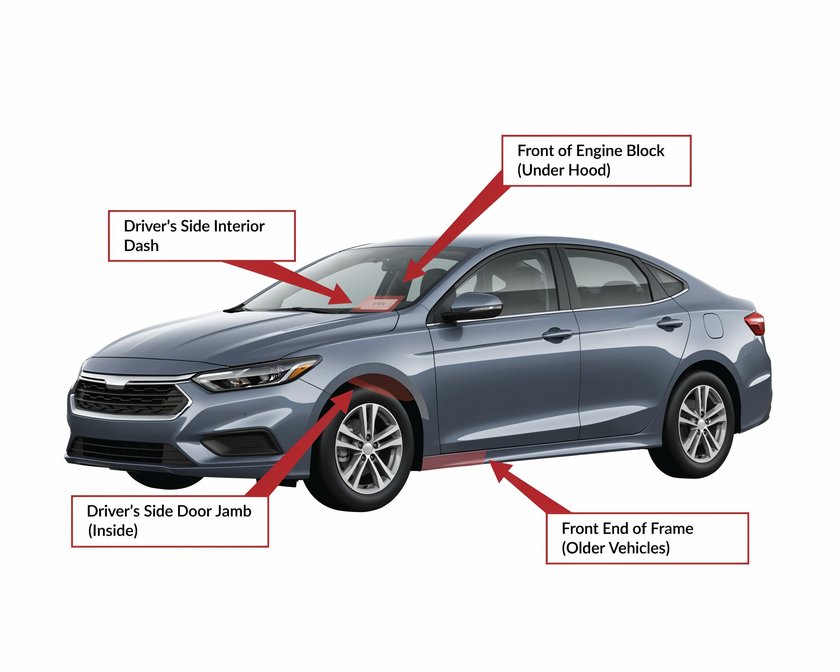
If you're checking a truck in person rather than from a listing, there are four places to look — and it's worth confirming they all match:
- Dashboard, driver's side — visible through the windshield from outside the truck.
- Driver's door jamb sticker — also lists GVWR, tire pressure specs, and the paint code.
- Frame stamp — near the front bumper support, visible from underneath; a mismatch here can indicate a frame swap.
- Title, registration, and insurance card — should match the physical VIN exactly, character for character.

Why Decoding the VIN Matters Before You Buy
A VIN decode isn't just trivia — it's a fast way to catch problems before they become your problem:
Recalls follow the VIN, not the listing. Toyota has issued several Tacoma-specific safety recalls in recent years: a February 2025 campaign for rear brake hoses on 2024–2025 4WD models that can leak after mud and dirt buildup, a 2026 recall covering roughly 48,000 2024–2025 TRD Off-Road trucks for corrosion-prone shock absorber reservoirs, and a 2026 campaign for defective replacement side-curtain airbags on 2014–2023 models. Older second-generation trucks (2005–2010) carry a well-documented history of frame rust recalls and buybacks. Running the VIN through NHTSA's recall lookup takes under a minute and tells you whether open work is outstanding.
Fraud tracks the used-truck market's popularity. Carfax's 2025 data found roughly 2.45 million vehicles nationwide suspected of odometer rollbacks — a 14% increase year over year — and the National Insurance Crime Bureau has long warned that VIN cloning, where a stolen vehicle is given a legitimately registered truck's VIN, disproportionately targets popular, high-demand models. A Tacoma, as the best-selling midsize truck in America for two decades running, fits that profile.
A decoded VIN is a starting point, not the finish line. Toyota-specific decoders (including this one) and NHTSA's own vPIC database will confirm year, plant, and factory specs, but they won't catch title washing, undisclosed liens, or accident history — for that, pair the decode with a full vehicle history report and a pre-purchase inspection.
Run a free Tacoma VIN check to confirm everything above against your specific truck.
Conclusion
A Tacoma VIN packs in more useful information than most buyers realize: exact model year, the specific factory that built it, engine and cab configuration, and a built-in way to catch inconsistencies before you hand over money. Between record sales, rising resale values, and a documented uptick in odometer and VIN fraud, running the number is one of the fastest, lowest-effort checks you can do on any used Tacoma.
Decode Your Toyota Tacoma VIN Free
Instant results. No signup required.
Decode Your Toyota VIN
Pull the real history behind any car — recalls, title brands, odometer trail.
Our Services
Generate and print an authentic window sticker for any Toyota vehicle using its VIN.
Obtain a comprehensive factory build sheet detailing all specifications for any Toyota using its VIN.
Access unlimited vehicle history reports and detailed information for Toyota dealerships.
Find the exact paint code and color details for a Toyota by VIN.
Look up factory-installed options and packages for any Toyota by VIN.
Check the warranty status and coverage details of a Toyota by VIN.
Retrieve detailed specifications, including engine, transmission, and dimensions, for any Toyota by VIN.
Frequently Asked Questions
It's the model year code. Because the code cycles every 30 years, you need to already know roughly which generation you're looking at — "R" is 2024, not 1994, on a Tacoma with a 3TM or 3TY WMI and a modern VDS pattern.
On the dashboard (visible through the windshield on the driver's side), on a sticker inside the driver's door jamb, stamped into the frame near the front bumper, and printed on the title and registration.
Check the WMI (first three characters) and the plant code (11th character). Every 2024-and-later Tacoma is built in Mexico (3TM/M for Baja California, 3TY/T for Guanajuato). Earlier trucks may show a Z (Fremont, California) or X (San Antonio, Texas) plant code instead.
For federal safety data — recalls, basic specs, manufacturer — yes, especially NHTSA's own vPIC tool. For Toyota-specific trim, engine, and options detail, a decoder built specifically around Toyota's VDS conventions (like this one) will usually be more complete, though it's still worth cross-checking against the door jamb sticker.
The 9th character is a value calculated from the other 16 characters using a fixed formula. It exists purely to catch typos or tampering — if a VIN fails the check-digit calculation, at least one character was entered or altered incorrectly.
Related Guides
Where Are Toyota Tundras Made? Tundra Manufacturing Locations | Toyota Vin Decoder
Find out where Toyota Tundras are made. Learn about the Tundra's manufacturing plants, production history, and its American-made roots. Get your VIN report now!
What Does LE Stand For Toyota? Trim Level Guide & VIN Decoder
Uncover the meaning of Toyota LE trim levels. Discover features, compare trims, and decode your VIN. Learn about SE, XLE, and more. Get the details here!
Toyota Transmission Fluid Change: Timing, Cost & Instructions
Need to change your Toyota transmission fluid? Find out how often, what it costs, and how to do it. Get the best advice and keep your Toyota running smoothly.

Grinding Noise When Accelerating: Causes & Solutions | Toyota VIN Decoder
Experiencing a grinding noise when accelerating? This guide explains common causes like wheel bearings, brakes, and more. Get expert advice and solutions for your car.
Bank 1 Sensor 2 Upstream or Downstream? Location & Function
Demystifying Bank 1 Sensor 2. Is it upstream or downstream? Find out the exact location, what it does, and how to troubleshoot problems. Get insights and resources for your Toyota at ToyotaVinDecoder.com.

Modded Toyota Camry: Customization, Mods, and Styling Guide
Discover the best modded Toyota Camry ideas! Learn about performance upgrades, styling, and customization. Find inspiration for your own Camry mods.
Decode Your Toyota VIN Free
Get instant results. No signup required.