Toyota Camry VIN Decoder: How to Read Every Character in Your VIN
Find your VIN, decode the model year and generation, check open recalls, and spot odometer fraud before you buy.
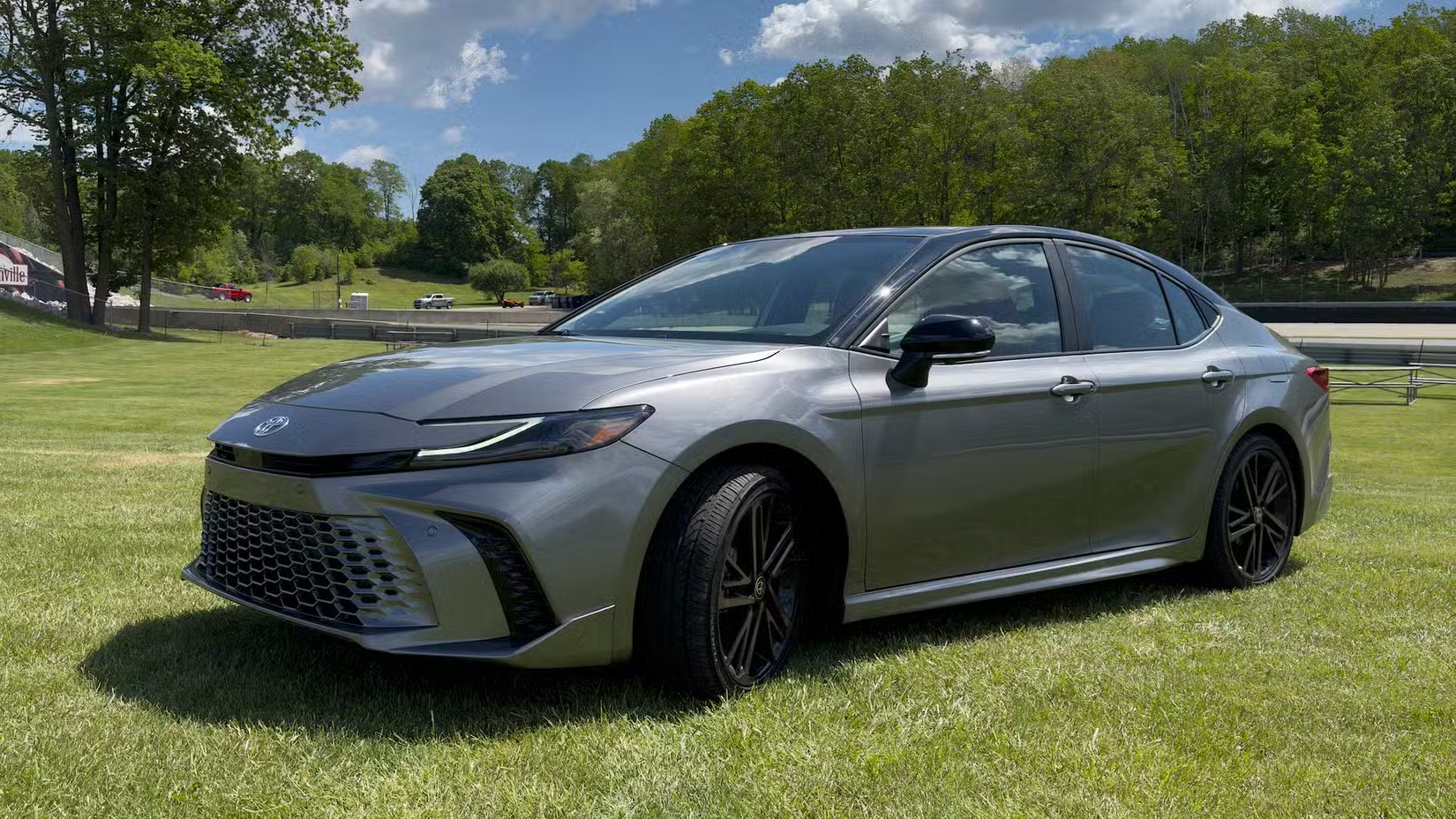
Every Toyota Camry built since the 1981 model year carries a 17-character VIN that quietly records its model year, generation, assembly plant, and full production history. Whether you're buying a used Camry, double-checking a seller's claims, or just curious what your dashboard sticker actually means, decoding those 17 characters takes less time than reading this paragraph twice.
This guide covers where to find the VIN on a Camry, what each section of it encodes, how to pull the model year and generation from a single character, and why a full VIN check matters more than ever — odometer fraud alone is now flagged on an estimated 2.45 million U.S. vehicles.
Key Takeaways
- A Camry VIN splits into three blocks: manufacturer/country (positions 1–3), vehicle description (4–8), and a unique production record (9–17).
- The 10th character alone tells you the model year — no lookup tool required once you know the code.
- U.S.-market Camrys typically carry a WMI starting with 4T1 (Kentucky-built) or JT (Japan-built).
- CARFAX estimates 2.45 million vehicles on U.S. roads had rolled-back odometers in 2025 — up 14% from 2024.
- Free, official decoding is available through NHTSA's vPIC database or the ChassisVIN Camry VIN decoder below.
What a Toyota Camry VIN Actually Encodes
A VIN (Vehicle Identification Number) is a 17-character alphanumeric string, standardized under U.S. federal regulation for every road vehicle built from the 1981 model year forward. No two Camrys share the same VIN within a 30-year span, and the format is consistent enough that you can hand-decode most of it without any software — the National Highway Traffic Safety Administration's vPIC database exists specifically to make this data public and free.
[INTERNAL-LINK: decode your own VIN instantly — Camry VIN decoder tool]
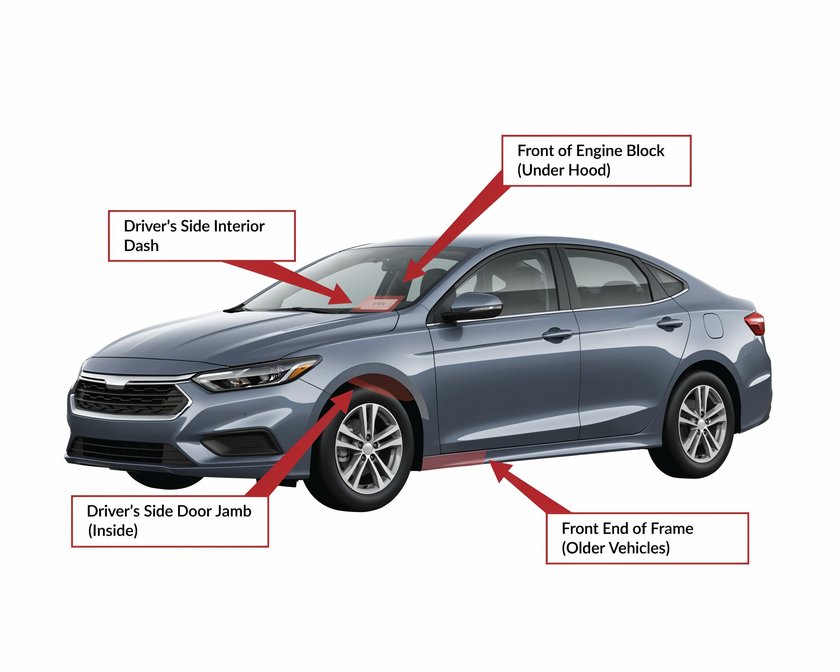
Where to Find the VIN on a Toyota Camry
Before you can decode anything, you need an accurate 17-character string. On a Camry, look in these spots:
- Driver's-side dashboard — visible through the windshield from outside the car, at the base of the glass.
- Driver's door jamb — a white sticker also lists tire size, paint code, and production date.
- Engine bay — stamped on the firewall or a plate near the front of the engine compartment.
- Title, registration, and insurance documents — all three are legally required to list the VIN.
If your VIN reads as fewer than 17 characters, you're likely looking at a pre-1981 vehicle, which predates the federal 17-digit standard — extremely unlikely for anything on the used Camry market today.
The Three Sections of a Camry VIN, Position by Position
| Positions | Section | What it tells you |
|---|---|---|
| 1–3 | World Manufacturer Identifier (WMI) | Manufacturer, country of origin, and general vehicle type |
| 4–8 | Vehicle Descriptor Section (VDS) | Body style, engine, series, and restraint system — Toyota-assigned and reused differently across model years |
| 9 | Check digit | A federally mandated value calculated from the other 16 characters, used to catch transcription errors |
| 10 | Model year | A single letter or number, covered below |
| 11 | Assembly plant | The specific factory that built the car |
| 12–17 | Sequential production number | The unique serial for that individual vehicle |
Positions 1–3 (WMI): U.S.-market Camrys are built at Toyota's Georgetown, Kentucky plant (TMMK) and at Toyota's Tsutsumi plant in Japan, depending on the model year and trim, so you'll typically see a WMI starting with 4T1 or 4T3 (Kentucky-built) or JT — such as JTD, JTE, or JTH (Japan-built). The third character generally flags the vehicle category under the federal WMI standard, with "1" commonly denoting a passenger car.
Positions 4–8 (VDS): This block is where Toyota encodes body type, engine family, and trim — but the exact character-to-feature mapping is reassigned as Toyota introduces new engines, safety packages, and trims across generations. There's no single static table that decodes this section accurately for every Camry year, which is exactly why a live NHTSA vPIC or ChassisVIN lookup beats a printed chart.
Position 9 (check digit): This is a calculated value, not descriptive data — it exists purely so a computer (or a sharp-eyed clerk) can catch a mistyped VIN before it's registered.
Positions 12–17 (serial): The final six characters are the sequential number assigned to that specific car on the line — no two Camrys built at the same plant in the same model year share this string.
Decode the Model Year From the 10th Character
This is the single most useful shortcut in the whole VIN. The 10th character has followed the same federal cycle since 1981, repeating every 30 years and skipping the letters I, O, Q, U, and Z to avoid confusion with numbers. Here's the range relevant to any Camry currently on the used market:
| Code | Model Year | Code | Model Year |
|---|---|---|---|
| A | 2010 | K | 2019 |
| B | 2011 | L | 2020 |
| C | 2012 | M | 2021 |
| D | 2013 | N | 2022 |
| E | 2014 | P | 2023 |
| F | 2015 | R | 2024 |
| G | 2016 | S | 2025 |
| H | 2017 | T | 2026 |
| J | 2018 |
Take the VIN 4T1BF1FKXFU876481 as a worked example: position 10 is F, which maps to 2015 — and this VIN does, in fact, belong to a 2015 Toyota Camry LE. That's the entire lookup, no software required.
Which Camry Generation Matches Your VIN?
Once you have the model year, matching it to a generation tells you the platform, base engine lineup, and safety-tech baseline you're working with.
- XV50 (2012–2017): Narrow-body-to-wide-body mid-size sedan on Toyota's older K platform, offered with 2.5L four-cylinder, 3.5L V6, and hybrid powertrains.
- XV70 (2018–2024): Built on the TNGA-K platform starting with the 2018 model year, debuted at the 2017 North American International Auto Show, and ran through the 2024 model year in the U.S.
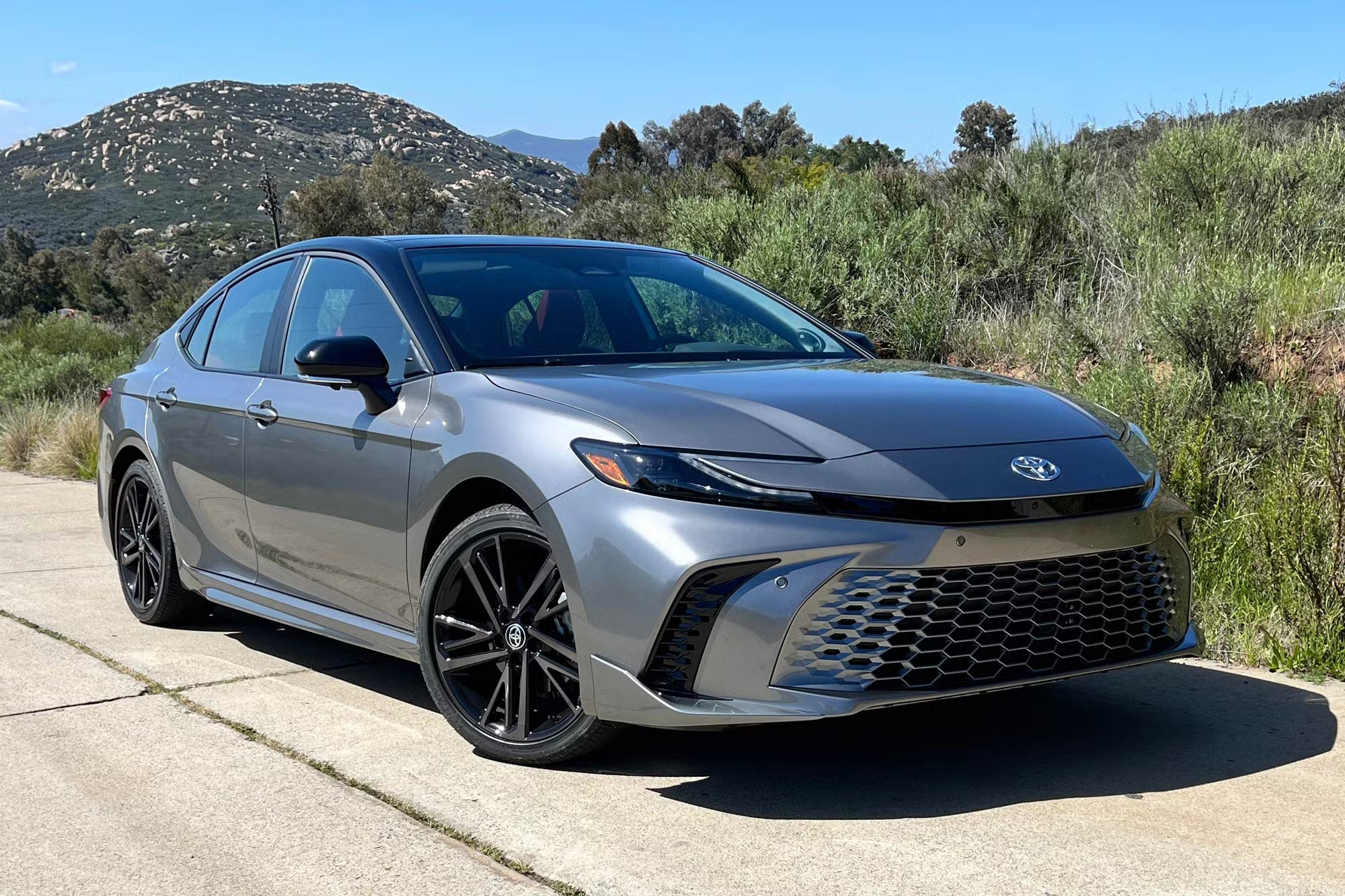
- XV80 (2025–present): The current generation, produced from October 2023 in China and April 2024 for the U.S. market. Toyota's own pressroom materials note the Camry has held the best-selling sedan title in the U.S. for 22 consecutive years, and the XV80 marked a significant shift: it dropped the gasoline-only option entirely and became hybrid-only, with all-wheel drive offered for the first time across every trim.
[INTERNAL-LINK: see full specs for every Camry generation — Camry generations guide]
Why Run a Full VIN Check Before You Buy a Used Camry
Decoding the year and plant is a good start, but it only tells you what the car should be — not what's actually happened to it. Two risks are worth checking specifically before you hand over money for a used Camry.
Odometer fraud is climbing fast. Based on its own vehicle history data, CARFAX reported an "alarming spike" in odometer rollbacks in 2025, estimating that roughly 2.45 million vehicles on U.S. roads may have tampered odometers — a 14% jump from 2024. NHTSA separately estimates that more than 450,000 vehicles are sold with false odometer readings every year, costing American consumers over $1 billion annually. A CARFAX spokesperson noted that buyers typically lose around $3,300 in value on a car with a rolled-back odometer, on top of higher breakdown risk from unaccounted-for wear.
Digital odometers made this worse, not better — resetting a digital reading leaves none of the physical tampering evidence an old mechanical odometer would show, and the tools to do it are cheap and widely available online.
The Camry's own popularity is a target. With 22 years as America's best-selling sedan and Toyota reporting hundreds of thousands of annual U.S. sales, there's an enormous used Camry pool for this kind of fraud to hide in. A VIN-based history check cross-references the odometer readings on file against DMV, service, and inspection records — something no visual inspection can replicate.
Trim and year affect what a fair price even looks like. The 2025 switch to a hybrid-only lineup pushed the Camry's starting price to roughly $28,400–$28,700, up from around $26,400 for the outgoing gasoline-based model — so knowing the exact year and trim from the VIN matters before you can judge whether an asking price is reasonable.
[INTERNAL-LINK: pull a full Camry vehicle history report — VIN report page]
Common Toyota Camry Recalls Worth Checking by VIN
A VIN check also surfaces open safety recalls tied to that specific car — repairs that are free at any Toyota dealer but easy for a private seller to forget to mention. Several campaigns have touched recent Camry model years:
- 2018–2020 Camry — fuel pump recall (NHTSA campaign 20V682000): Part of a sweeping multi-model Toyota and Lexus recall for a low-pressure fuel pump that could fail inside the tank.
- 2018–2019 Camry — brake power-assist recall (NHTSA campaign 21V890000, Nov. 2021): Roughly 227,400 Camrys were recalled after Toyota found components in the brake vacuum-assist system could wear prematurely.
- 2020–2022 Camry and Camry Hybrid — airbag sensor recall (NHTSA campaign 23V865000): A short circuit risk in the Occupant Classification System sensor that can prevent the front passenger airbag from deploying; this is a phased recall with remedy work continuing into 2026.
- 2023 Camry and Camry Hybrid — lug nut recall (NHTSA campaign 23V432000, June 2023): Loose wheel lug nuts that could lead to wheel detachment.
- 2023–2024 Camry and Camry Hybrid — seat recall: A separate campaign covering certain seat components on early XV80-era production.
- 2025 Camry — instrument cluster software recall (NHTSA campaign 25V595000): Part of a broad multi-model over-the-air software update for the instrument panel display.
Recall status is tied to the individual VIN, not just the model year, so the only reliable way to know whether a specific Camry still has open work is to run its VIN — either through NHTSA's own recall lookup or a full ChassisVIN report.
[INTERNAL-LINK: check open recalls on this VIN — recall checker tool]
How to Decode Your Camry's VIN for Free
You have two solid free options, and they're not redundant with each other:
- NHTSA's vPIC database — the official, government-maintained source. It's free, requires no account, and covers every U.S.-market vehicle from model year 1981 onward. It decodes the manufacturer data (make, model, body, engine, plant) but doesn't include recalls, complaints, or market value in the same lookup.
- [ChassisVIN's Camry VIN decoder] — pulls the same NHTSA vPIC data and layers in open recalls, federal owner complaints, and comparable market pricing in a single report, so you're not stitching together three separate government tools.
[INTERNAL-LINK: run your Camry's VIN now — Camry VIN decoder tool]

Decode Your Camry's VIN Now
Every character in a Camry's VIN is public, federally standardized data — you don't need to guess, and you shouldn't have to take a seller's word for the model year, plant, or recall history. Paste the VIN into the tool below to get the full picture in one pass.
[INTERNAL-LINK: get your free Camry VIN report — Camry VIN decoder tool]
[INTERNAL-LINK: browse VIN decoders for other Toyota models — Toyota VIN decoder hub]
- What a Toyota Camry VIN Actually Encodes
- Where to Find the VIN on a Toyota Camry
- The Three Sections of a Camry VIN, Position by Position
- Decode the Model Year From the 10th Character
- Which Camry Generation Matches Your VIN?
- Why Run a Full VIN Check Before You Buy a Used Camry
- Common Toyota Camry Recalls Worth Checking by VIN
- How to Decode Your Camry's VIN for Free
- Decode Your Camry's VIN Now
Pull the real history behind any car — recalls, title brands, odometer trail.
Frequently Asked Questions
Check the driver's-side dashboard (visible through the windshield), the driver's door jamb sticker, or the vehicle's title, registration, and insurance documents. It's also stamped in the engine bay on most Camry model years.
It's the model year code. For any Camry built since 2010, match the letter or number against the standard federal chart above — for example, "R" means 2024 and "S" means 2025.
Yes. NHTSA's vPIC database is free and official, and [ChassisVIN's Camry decoder] is also free for a basic decode, with recalls, complaints, and pricing data included in the report.
Partial decoding is possible — NHTSA's vPIC API supports partial VINs — but you'll get far less reliable results without the full 17 characters, especially for the model-year and plant positions.
Run the full VIN through NHTSA's recall lookup or a ChassisVIN report. Recall status is specific to the individual VIN, not just the model year, so two 2019 Camrys can have different open-recall statuses depending on repair history.
Related Guides

Where Are Toyota Tundras Made? Tundra Manufacturing Locations | Toyota Vin Decoder
Find out where Toyota Tundras are made. Learn about the Tundra's manufacturing plants, production history, and its American-made roots. Get your VIN report now!
What Does LE Stand For Toyota? Trim Level Guide & VIN Decoder
Uncover the meaning of Toyota LE trim levels. Discover features, compare trims, and decode your VIN. Learn about SE, XLE, and more. Get the details here!

Toyota Transmission Fluid Change: Timing, Cost & Instructions
Need to change your Toyota transmission fluid? Find out how often, what it costs, and how to do it. Get the best advice and keep your Toyota running smoothly.

Grinding Noise When Accelerating: Causes & Solutions | Toyota VIN Decoder
Experiencing a grinding noise when accelerating? This guide explains common causes like wheel bearings, brakes, and more. Get expert advice and solutions for your car.
Bank 1 Sensor 2 Upstream or Downstream? Location & Function
Demystifying Bank 1 Sensor 2. Is it upstream or downstream? Find out the exact location, what it does, and how to troubleshoot problems. Get insights and resources for your Toyota at ToyotaVinDecoder.com.

Modded Toyota Camry: Customization, Mods, and Styling Guide
Discover the best modded Toyota Camry ideas! Learn about performance upgrades, styling, and customization. Find inspiration for your own Camry mods.