Toyota Prius VIN Decoder: How to Read Every Character
Decode any Toyota Prius VIN yourself — WMI, check digit, model year code, plant code, and chassis codes for every generation from the NHW11 to the XW60.
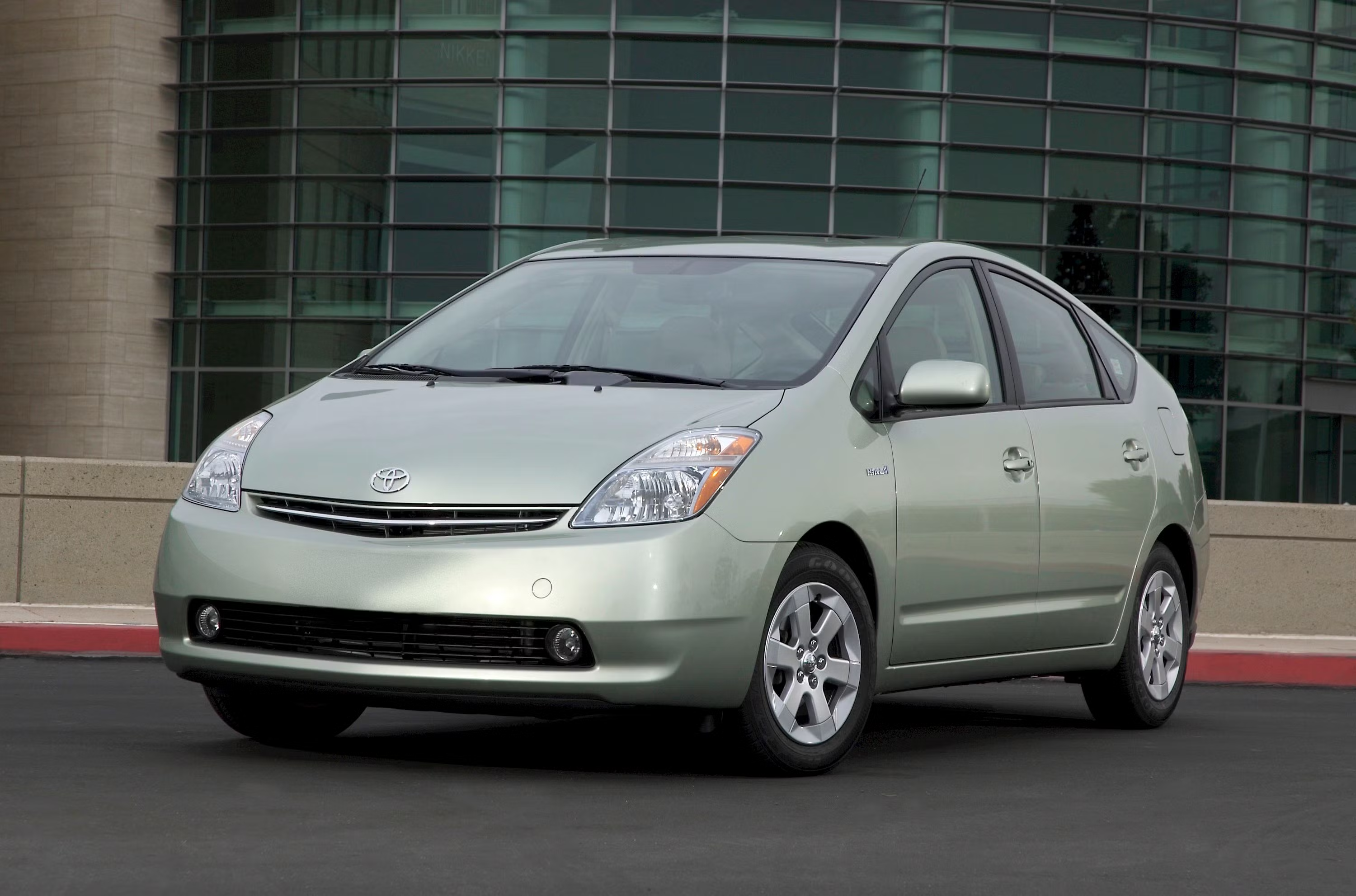
Every Toyota Prius carries a 17-character Vehicle Identification Number that quietly records where it was built, which generation it belongs to, what engine is under the hood, and its exact spot in Toyota's production run. Most owners never look past the sticker it's printed on — but if you're buying a used Prius, filing an insurance claim, or just trying to confirm a listing is telling the truth, decoding it takes less than a minute once you know what each position means.
New to VIN decoding? Start with how to decode any VIN, step by step.
This guide breaks the Prius VIN down character by character, gives you the chassis-code chart for every generation from the original NHW11 to the current XW60, and shows you how to use the VIN to pull a recall history before you sign anything.
Key Takeaways
- Positions 1–3 (JTD) identify Japan, Toyota, and passenger-car type — true for nearly every U.S.-market Prius liftback ever built.
- Position 9 is a check digit that mathematically validates the whole VIN; position 10 is the model year, and it uses numbers for 2001–2009 and letters from 2010 onward.
- The 4th–8th characters shift meaning by generation, since Toyota reuses the Vehicle Descriptor Section differently for each chassis platform (NHW20, ZVW30, XW50, XW60).
- Toyota has issued several major Prius recalls by VIN range — from the 2010 ABS software fix to a 2026 rear-door-switch campaign — so a VIN check is worth doing before you buy.

Toyota Prius VIN Structure: What Each Character Means
A VIN is always 17 characters, split into three sections, and the Prius follows the same layout as every other modern Toyota:
| Position | Section | What It Identifies |
|---|---|---|
| 1–3 | World Manufacturer Identifier (WMI) | Country, manufacturer, and vehicle/division type |
| 4–8 | Vehicle Descriptor Section (VDS) | Body style, engine family, chassis series, restraint system |
| 9 | Check Digit | A calculated value (0–9 or X) used to catch transcription errors |
| 10 | Model Year | A single letter or number for the model year |
| 11 | Plant Code | The assembly plant that built the car |
| 12–17 | Vehicle Descriptor Section (VIS) | Sequential production/serial number |
For the World Manufacturer Identifier, nearly every U.S.-market Prius liftback — from the first generation through the current one — starts with JTD:
- J — Country of origin: Japan
- T — Manufacturer: Toyota
- D — Vehicle type: passenger car (Toyota Sales USA classification)
That's a useful sanity check on its own: if a VIN on a "Prius" listing doesn't start with JTD (and isn't a Prius v, Prius c/Aqua, or a car built for a different market), it's worth a closer look.
Prius Chassis Codes and VIN Patterns by Generation
Toyota reuses the 4th–8th characters (the VDS) differently for every chassis platform, so the pattern that decodes a 2007 Prius won't line up with a 2020 one. Here's how the generations break down:
| Generation | Chassis Code | Model Years | Engine | Typical VIN Pattern |
|---|---|---|---|---|
| 1st gen | NHW11 | 2001–2003 | 1.5L 1NZ-FXE | JTDBW... |
| 2nd gen | NHW20 | 2004–2009 | 1.5L 1NZ-FXE | JTDKB2... |
| 3rd gen | ZVW30 | 2010–2015 | 1.8L 2ZR-FXE | JTDKN3D... |
| 3rd gen (plug-in) | ZVW35 | 2012–2015 | 1.8L 2ZR-FXE + Li-ion | JTDKN3DP... |
| 4th gen | ZVW51/ZVW52 | 2016–2022 | 1.8L 2ZR-FXE | JTDKARFU... |
| 4th gen Prime | ZVW52 | 2017–2022 | 1.8L 2ZR-FXE + Li-ion | JTDKARFP... |
| 5th gen | ZVW60/65, MXWH60/65 | 2023–present | 2.0L M20A-FXS or 1.8L 2ZR-FXE | JTDACAAU... |
A few notes on reading that table:
- Position 4 is generally the engine family code, and it's the character that changes most across generations — Toyota moved from the smaller 1.5L 1NZ-FXE (gens 1–2) to the 1.8L 2ZR-FXE (gens 3–4, and the base gen 5) and, for some 2023+ trims, the larger 2.0L M20A-FXS.
- Position 6 commonly encodes the chassis series (you'll sometimes see this referred to informally as "which NHW/ZVW/XW number" the car is), though Toyota has never published an official public key to the VDS, so these patterns come from cross-referencing owner-submitted VINs rather than a factory manual.
- Because the VDS isn't officially published, the safest way to confirm an exact trim, engine, and factory options is to run the full VIN through a proper decoder rather than eyeballing it.
Need it for a different Toyota? Try our free VIN lookup tool for any Toyota.
Decoding the Model Year (Position 10)
This is the character most buyers actually need, and it's the one place the Prius's long production run makes things slightly more interesting than most cars: it spans both eras of the standard VIN model-year code.
2001–2009 (numeric era):
| Code | Year | Code | Year |
|---|---|---|---|
| 1 | 2001 | 6 | 2006 |
| 2 | 2002 | 7 | 2007 |
| 3 | 2003 | 8 | 2008 |
| 4 | 2004 | 9 | 2009 |
| 5 | 2005 |
2010–2026 (letter era):
| Code | Year | Code | Year | Code | Year |
|---|---|---|---|---|---|
| A | 2010 | H | 2017 | P | 2023 |
| B | 2011 | J | 2018 | R | 2024 |
| C | 2012 | K | 2019 | S | 2025 |
| D | 2013 | L | 2020 | T | 2026 |
| E | 2014 | M | 2021 | ||
| F | 2015 | N | 2022 | ||
| G | 2016 |
The letters I, O, Q, U, and Z are skipped industry-wide to avoid confusion with the numbers 1 and 0 — so if a VIN's 10th character is one of those, something's been mistyped or altered.
The Check Digit and Plant Code
Position 9 — check digit: every VIN sold in North America since 1981 includes a check digit, a single number (or the letter X) calculated from a weighted formula across the other 16 characters. It exists purely to catch typos — a dealer, DMV clerk, or insurance form that transposes two characters will usually fail the check-digit math, which is one reason a "close but not quite" VIN on a title should raise a flag rather than get shrugged off.
Position 11 — plant code: this identifies the specific assembly plant. Nearly every U.S.-market Prius, across every generation, traces back to Toyota's Tsutsumi plant in Toyota City, Aichi, Japan, with the Fujimatsu plant in nearby Kariya adding second-generation volume starting in 2004. Toyota has never sold a Japan-market-only, North-American-built Prius liftback, which is part of why the WMI and plant data stay so consistent across 20-plus years of production.
How to Find the VIN on a Toyota Prius
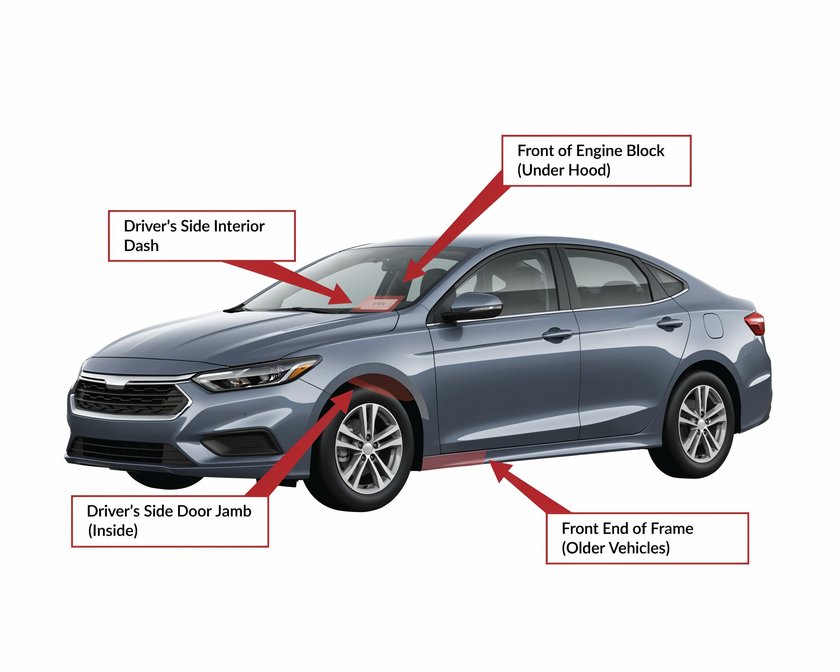
If you're standing in front of the actual car rather than a listing, the VIN shows up in three consistent spots on every generation:
- Dashboard, driver's side — visible through the windshield from outside, at the base of the windshield on the dash.
- Driver's door jamb — on the sticker or plate on the door frame, visible when the door is open.
- Registration, title, and insurance card — anywhere the car is officially documented.
You'll also find it stamped on the engine block and, for hybrids specifically, sometimes referenced on a secondary label near the hybrid battery compartment — useful if the dash plate has been damaged or swapped, which is itself a red flag worth investigating.
Why Decoding Your Prius VIN Matters Before You Buy
Beyond confirming the model year and trim match what a seller claims, the VIN is what recall and service databases key off of. The Prius has had several large recall campaigns over its production life, and running the VIN is the only reliable way to know whether a specific car has an open one:
The pattern worth noticing: recalls have hit every generation, and several — like the 2012 steering-column campaign and the 2026 door-switch campaign — cut across multiple model years at once. A VIN-based recall check takes seconds and costs nothing, and it's a step worth taking even on a Prius that looks and drives fine.
Check this Prius for open recalls — it takes seconds.
Bottom Line
The Prius VIN follows the same 17-character logic as any other modern car, but its two-decade production run means it's one of the few nameplates where you'll see both the numeric and alphabetic model-year eras in circulation. Once you can place a VIN's generation, engine, and plant, the rest — pulling a full history, checking for open recalls, verifying a title — is just a matter of running it through a proper decoder.
Decode Your Toyota Prius VIN Free
Instant results. No signup required.
Pull the real history behind any car — recalls, title brands, odometer trail.
Our Services
Generate and print an authentic window sticker for any Toyota vehicle using its VIN.
Obtain a comprehensive factory build sheet detailing all specifications for any Toyota using its VIN.
Access unlimited vehicle history reports and detailed information for Toyota dealerships.
Find the exact paint code and color details for a Toyota by VIN.
Look up factory-installed options and packages for any Toyota by VIN.
Check the warranty status and coverage details of a Toyota by VIN.
Retrieve detailed specifications, including engine, transmission, and dimensions, for any Toyota by VIN.
Frequently Asked Questions
It identifies the country and manufacturer, the vehicle type, the body style and engine family, the model year, the assembly plant, and the car's unique production sequence number. Combined with a lookup service, it also unlocks recall history, registration history, and reported accident or title records.
On the dashboard at the base of the windshield (visible from outside on the driver's side), on a sticker inside the driver's door jamb, and on the title, registration, and insurance documents. It's also stamped on the engine block.
Look at the 10th character. For model years 2001–2009 it's a number (1 = 2001 through 9 = 2009); from 2010 onward it's a letter (A = 2010 through T = 2026), skipping I, O, Q, U, and Z.
Almost all U.S.-market Prius liftbacks do, since they're built at the same Japanese plants. Related models sold under different nameplates — the Prius c (badged as the Toyota Aqua in Japan) or vehicles built for other regional markets — can carry different WMI codes, so JTD is a strong pattern but not an absolute rule across the whole Prius family.
Enter the full 17-character VIN into a VIN decoder or recall-lookup tool — run a free recall check here. Because Toyota's recall campaigns are issued by VIN range rather than by model year alone, this is more reliable than checking the model year against a recall list by hand.
Related Guides

Where Are Toyota Tundras Made? Tundra Manufacturing Locations | Toyota Vin Decoder
Find out where Toyota Tundras are made. Learn about the Tundra's manufacturing plants, production history, and its American-made roots. Get your VIN report now!

What Does LE Stand For Toyota? Trim Level Guide & VIN Decoder
Uncover the meaning of Toyota LE trim levels. Discover features, compare trims, and decode your VIN. Learn about SE, XLE, and more. Get the details here!

Toyota Transmission Fluid Change: Timing, Cost & Instructions
Need to change your Toyota transmission fluid? Find out how often, what it costs, and how to do it. Get the best advice and keep your Toyota running smoothly.

Grinding Noise When Accelerating: Causes & Solutions | Toyota VIN Decoder
Experiencing a grinding noise when accelerating? This guide explains common causes like wheel bearings, brakes, and more. Get expert advice and solutions for your car.
Bank 1 Sensor 2 Upstream or Downstream? Location & Function
Demystifying Bank 1 Sensor 2. Is it upstream or downstream? Find out the exact location, what it does, and how to troubleshoot problems. Get insights and resources for your Toyota at ToyotaVinDecoder.com.

Modded Toyota Camry: Customization, Mods, and Styling Guide
Discover the best modded Toyota Camry ideas! Learn about performance upgrades, styling, and customization. Find inspiration for your own Camry mods.
Decode Your Toyota VIN Free
Get instant results. No signup required.