Toyota Land Cruiser VIN Decoder: How to Read Every Character (Plus a Generation Chart)
Decode a Toyota Land Cruiser VIN character by character — WMI, check digit, model year, and a generation chart from the FJ40 to the J300.
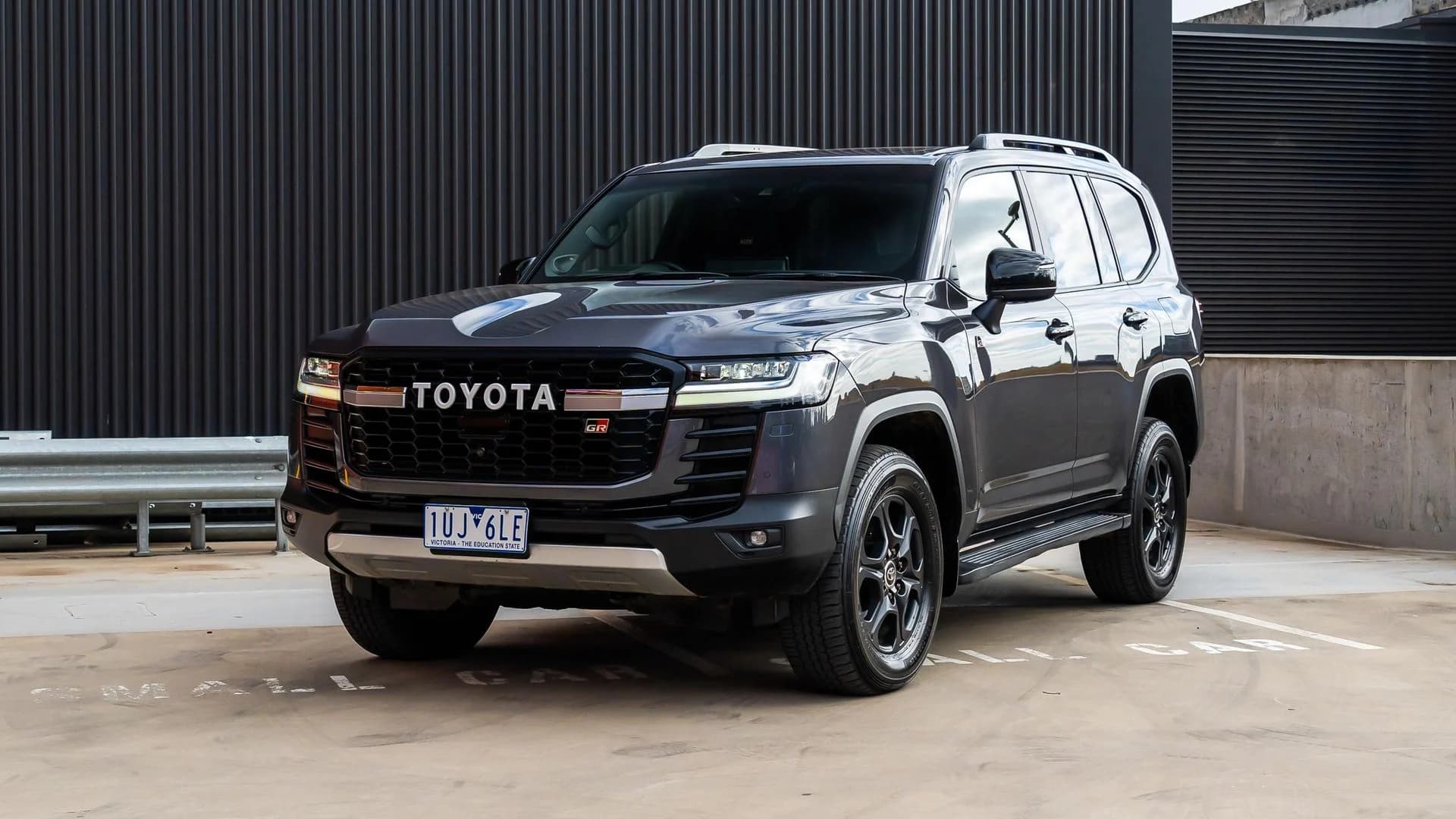
The Land Cruiser has run for 75 years across roughly ten generations, longer than any other Toyota nameplate, and its VIN carries more history than most. A 17-character code can tell you whether a truck is a Japan-built 200 Series or the newer 250 Series sold as "Land Cruiser" in the US and Canada, what year it left the factory, and whether the numbers on the dash actually match the paperwork.
This guide breaks the VIN down section by section, shows you how to calculate the check digit yourself, and maps every Land Cruiser generation to the years its VIN would show.
Key Takeaways
- A Toyota VIN has four sections: World Manufacturer Identifier (1–3), Vehicle Descriptor Section (4–8), check digit (9), and Vehicle Identifier Section (10–17).
- Land Cruisers built in Japan carry a WMI starting in "JT" — JTM is the code Toyota filed with NHTSA for the current Land Cruiser (200 and 300 Series).
- The 10th character is the model year, and the code cycles every 30 years — a "J" means 1988 or 2018, an "R" means 1994 or 2024.
- Since 2024, the "Land Cruiser" sold in the US and Canada is the 250 Series (Prado-based), not the full-size 300 Series sold in the rest of the world — the two use different VIN patterns.
- You can validate the 9th-character check digit yourself with a simple formula, which is the fastest way to catch a mistyped or altered VIN.
How a Toyota VIN Is Built
Every Toyota VIN — and every VIN built to the ISO 3779 standard used worldwide since the early 1980s — breaks into four parts:
| Position | Section | What it tells you |
|---|---|---|
| 1–3 | World Manufacturer Identifier (WMI) | Country, manufacturer, and vehicle type |
| 4–8 | Vehicle Descriptor Section (VDS) | Body style, engine, restraint system, series |
| 9 | Check digit | A calculated value used to catch VIN errors |
| 10 | Model year | Letter or number code, see the chart below |
| 11 | Plant code | Which factory built the vehicle |
| 12–17 | Serial number | The vehicle's unique sequence number |
Try our free Land Cruiser VIN decoder to run any VIN through it directly.
Characters 1–3: World Manufacturer Identifier (WMI)
The first three characters name the country, the manufacturer, and a general vehicle class. Every full-size Land Cruiser is built in Japan, so the WMI always starts with "J." Toyota has used a handful of different codes for the Land Cruiser family over the decades:
| WMI | Country | Manufacturer | Vehicle class | Land Cruiser era |
|---|---|---|---|---|
| JT3 | Japan | Toyota | Multipurpose passenger vehicle | Widely used on Japan-built export wagons through the 1980s |
| JT4 | Japan | Toyota | Truck | Pickup and troop-carrier variants from the same era |
| JTE | Japan | Toyota | Multipurpose passenger vehicle | Used on Land Cruiser-family vehicles from 2001 onward |
| JTM | Japan | Toyota | Multipurpose passenger vehicle | Current Land Cruiser (200 and 300 Series), per Toyota's VIN coding filing with NHTSA |
A WMI only narrows things down to "Toyota, Japan, this class of vehicle." It can't tell you the generation, engine, or trim on its own — for that you need the rest of the VIN, cross-checked against the vehicle in front of you.
Characters 4–8: Vehicle Descriptor Section (VDS)
This five-character block is where body style, grade, engine family, and restraint system live, but Toyota doesn't publish one universal key that covers every model year and market — the meaning of each position is defined internally and confirmed through Toyota's own filings or a VIN decoder.
One documented example, from Toyota's official VIN coding filing for the 200 Series: a 4-door wagon in VX-R grade with a 5.7 L V8 petrol engine and four-wheel drive uses specific 4th- and 5th-position codes tied to that exact configuration and restraint layout. That's useful as a sanity check — a seller claiming a diesel engine or a different body style than the VDS suggests is a reason to look closer — but a full, reliable read of this section needs Toyota's model-year-specific table or a decoder tool, not a printed cheat sheet.
Character 9: The Check Digit — and How to Calculate It Yourself
Position 9 exists purely to catch typos and forged VINs. It's calculated from the other 16 characters using a fixed formula, so if someone alters one character on a VIN plate, the check digit almost never matches anymore. You can run the math yourself with two tables.
Step 1 — convert each letter to a number:
Digits keep their own value. The letters I, O, and Q are never used in a VIN, so they don't appear in this table.
| Value | Letters |
|---|---|
| 1 | A, J |
| 2 | B, K, S |
| 3 | C, L, T |
| 4 | D, M, U |
| 5 | E, N, V |
| 6 | F, W |
| 7 | G, P, X |
| 8 | H, Y |
| 9 | R, Z |
Step 2 — multiply each position by its weight, then sum:
| Position | 1 | 2 | 3 | 4 | 5 | 6 | 7 | 8 | 9 | 10 | 11 | 12 | 13 | 14 | 15 | 16 | 17 |
|---|---|---|---|---|---|---|---|---|---|---|---|---|---|---|---|---|---|
| Weight | 8 | 7 | 6 | 5 | 4 | 3 | 2 | 10 | 0 | 9 | 8 | 7 | 6 | 5 | 4 | 3 | 2 |
Step 3 — divide the sum by 11. If the remainder is 10, the check digit is "X." Otherwise, the check digit is the remainder itself.
Worked example, using the illustrative VIN from the diagram above (JTMHU09J8R4123456):
| Pos | 1 | 2 | 3 | 4 | 5 | 6 | 7 | 8 | 10 | 11 | 12 | 13 | 14 | 15 | 16 | 17 |
|---|---|---|---|---|---|---|---|---|---|---|---|---|---|---|---|---|
| Char | J | T | M | H | U | 0 | 9 | J | R | 4 | 1 | 2 | 3 | 4 | 5 | 6 |
| Value | 1 | 3 | 4 | 8 | 4 | 0 | 9 | 1 | 9 | 4 | 1 | 2 | 3 | 4 | 5 | 6 |
| Weight | 8 | 7 | 6 | 5 | 4 | 3 | 2 | 10 | 9 | 8 | 7 | 6 | 5 | 4 | 3 | 2 |
| Product | 8 | 21 | 24 | 40 | 16 | 0 | 18 | 10 | 81 | 32 | 7 | 12 | 15 | 16 | 15 | 12 |
Sum of products = 327. 327 ÷ 11 = 29 remainder 8, so the check digit at position 9 is 8 — which matches the VIN as written. If you run this on a real VIN and the math doesn't land on the 9th character, treat that as a red flag before you send any money.
Character 10: Model Year
The 10th character cycles through letters and digits on a 30-year loop, skipping I, O, Q, U, Z, and the digit 0 to avoid look-alike characters.
| Code | 1980–2009 | 2010–2039 |
|---|---|---|
| A | 1980 | 2010 |
| B | 1981 | 2011 |
| C | 1982 | 2012 |
| D | 1983 | 2013 |
| E | 1984 | 2014 |
| F | 1985 | 2015 |
| G | 1986 | 2016 |
| H | 1987 | 2017 |
| J | 1988 | 2018 |
| K | 1989 | 2019 |
| L | 1990 | 2020 |
| M | 1991 | 2021 |
| N | 1992 | 2022 |
| P | 1993 | 2023 |
| R | 1994 | 2024 |
| S | 1995 | 2025 |
| T | 1996 | 2026 |
| V | 1997 | 2027 |
| W | 1998 | 2028 |
| X | 1999 | 2029 |
| Y | 2000 | 2030 |
| 1 | 2001 | 2031 |
| 2 | 2002 | 2032 |
| 3 | 2003 | 2033 |
| 4 | 2004 | 2034 |
| 5 | 2005 | 2035 |
| 6 | 2006 | 2036 |
| 7 | 2007 | 2037 |
| 8 | 2008 | 2038 |
| 9 | 2009 | 2039 |
Because the code repeats, an "H" alone could mean 1987 or 2017 — a J80-era Land Cruiser looks nothing like a 200 Series, so the ambiguity rarely matters in practice, but it's worth knowing if you're cross-checking an older import.
Character 11 and 12–17: Plant Code and Serial Number
Position 11 identifies the assembly plant, and the meaning is specific to each vehicle line rather than universal across Toyota's whole range. On Toyota's own filing for the current Land Cruiser, code 4 corresponds to the Yoshiwara plant (Toyota Auto Body) and code 5 to the Tahara plant (Toyota Motor Corporation) — both in Aichi Prefecture, Japan.
Characters 12 through 17 are the vehicle's unique sequential serial number within its production run. There's no decoding to do here beyond confirming the format is six digits or letters — it's the part of the VIN a dealer or parts counter uses to pull your exact build sheet.
Land Cruiser Generations, Mapped to the VIN
| Series | Production years | Known chassis prefixes | Notable |
|---|---|---|---|
| BJ/FJ, J20/J30 | 1951–1960 | BJ, FJ25, FJ35 | Prototype through the first civilian-market design |
| J40 | 1960–1984 (Brazil to 2001) | FJ40/43/45, BJ40/42, HJ45/47 | The icon — two-door, leaf-sprung, part-time 4WD |
| J50/J55 | 1967–1980 | FJ55 | First true station wagon body, nicknamed "the Moose" |
| J60 | 1980–1990 | FJ60/62, HJ60/61 | First Land Cruiser with air conditioning and a rear heater |
| J70 | 1984–present | Many, incl. 76/78/79 wagon, troop carrier, pickup | Only generation still in production, with no successor announced |
| J80 | 1990–1997 (some markets to 2008) | FZJ80, HZJ80, HDJ80 | Last full-size Land Cruiser with a solid front axle |
| J100 | 1998–2007 | UZJ100, HDJ100/101, HZJ105 | First V8, first independent front suspension |
| J200 | 2007–2021 | UZJ200, VDJ200 | Toyota's first turbo-diesel V8, introduced KDSS suspension |
| J300 | 2021–present | VJA300, FJA300, GRJ300, VJH300 (hybrid) | Twin-turbo V6 replaces the V8; not sold in the US or Canada |
| J250 | 2023–present | — | Prado-based; sold as "Land Cruiser" in the US and Canada from 2024 |
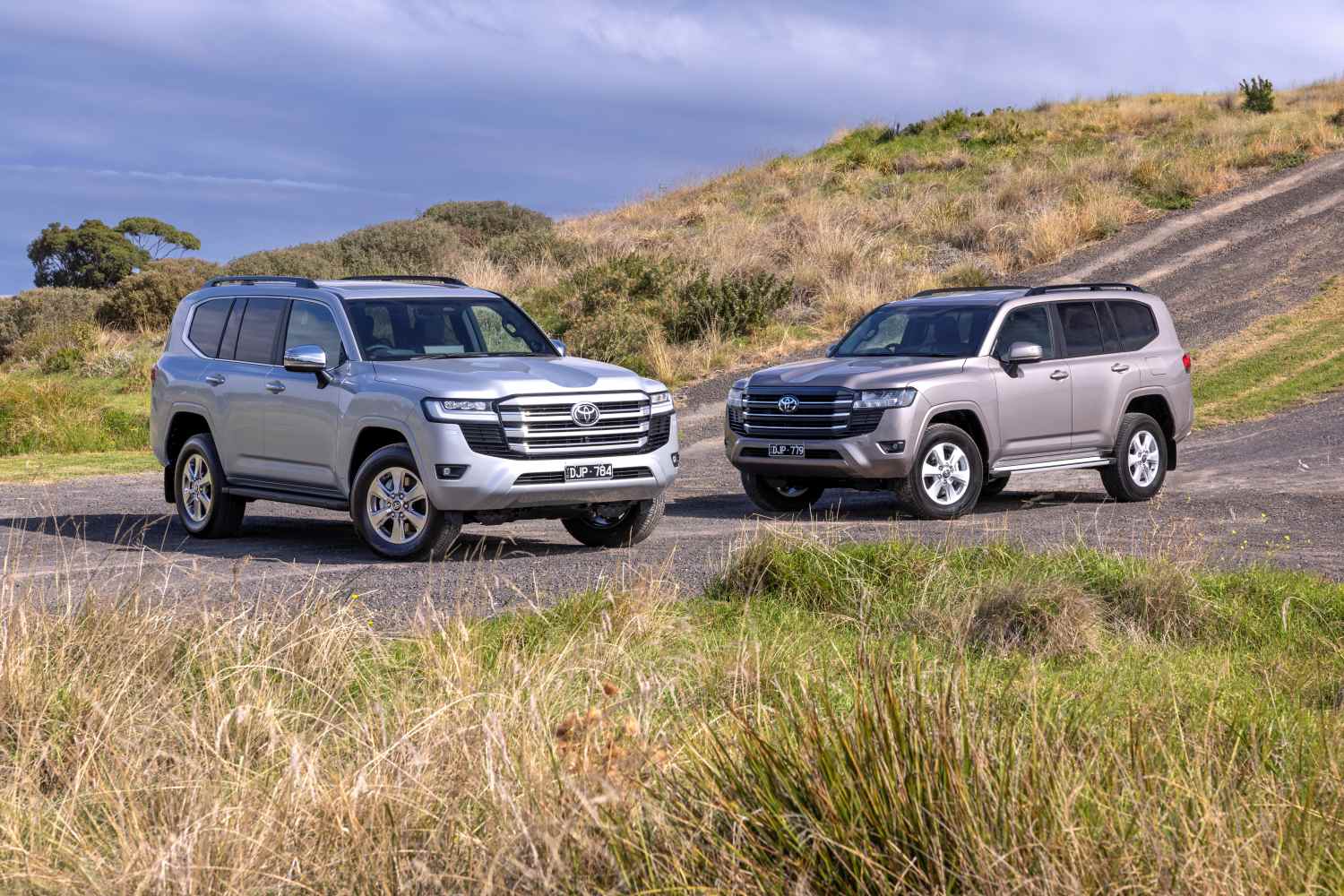
The last row is the one that trips people up. If you bought a new "Land Cruiser" in the United States or Canada in 2024 or later, it's built on the smaller, lighter-duty 250 Series platform — mechanically a Land Cruiser Prado — not the full-size 300 Series sold across the rest of the world. The two have different WMIs and VDS patterns, so a decoder result that doesn't match what you'd expect from a "real" 300 Series isn't necessarily wrong.
Check this VIN for recalls and complaints once you've confirmed which series you're looking at.
How to Find Your Land Cruiser's VIN
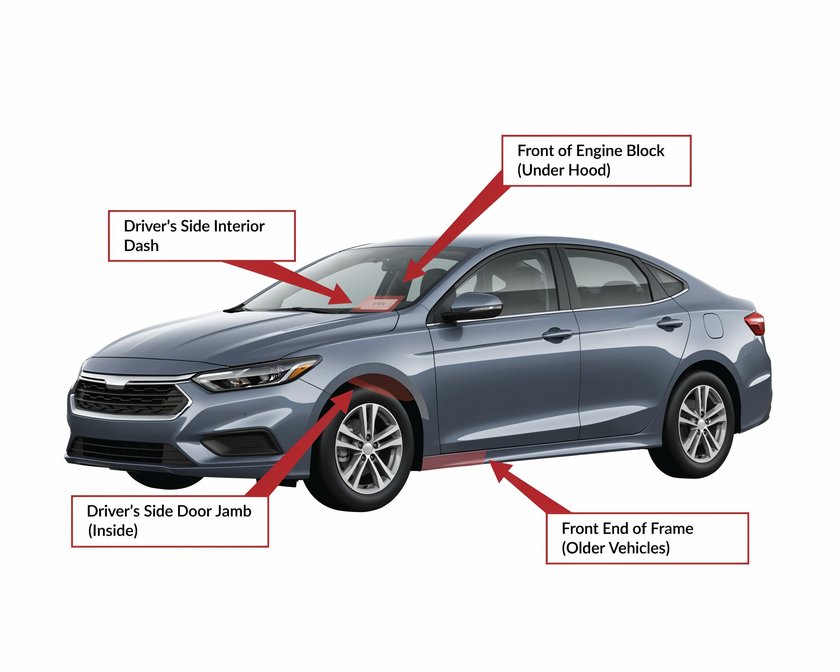
- Dashboard: on 80 Series and newer, look through the base of the windshield on the driver's side.
- Driver's door jamb: a sticker on the frame or door itself, usually listing the VIN alongside tire pressure and paint code.
- Engine bay: stamped on the firewall or frame rail on most generations.
- Frame stamp (J40/J55/J60): classic Land Cruisers often carry the VIN stamped directly into the front frame rail rather than on a dash plate.
- Registration and insurance documents: the fastest source if the vehicle isn't in front of you yet.
Why Decode the VIN Before You Buy
VIN cloning — taking the identity of a legally owned vehicle and applying it to a stolen or salvage one — has been a persistent problem in the used-vehicle market, and the National Insurance Crime Bureau has tracked rising cases since 2001. Land Cruisers are a particular target because of their resale value and global demand, especially for grey-market imports crossing borders where paperwork is harder to verify.
Before you commit to a purchase:
- Confirm the check digit yourself using the formula above.
- Cross-check the VIN against NHTSA's free vPIC decoder, which covers vehicles from model year 1981 onward.
- Compare what the VIN implies about body style and engine against the vehicle in person.
- Pull a full vehicle history report for accident, title, and odometer records the VIN alone won't surface.
Run a full VIN history check before you commit to a purchase.
Have a VIN you want decoded in full — body style, engine, and production plant included? Run it through our free Land Cruiser VIN decoder to get the complete build sheet.
Decode Your Land Cruiser VIN
Instant results. No signup required.
Pull the real history behind any car — recalls, title brands, odometer trail.
Our Services
Generate and print an authentic window sticker for any Toyota vehicle using its VIN.
Obtain a comprehensive factory build sheet detailing all specifications for any Toyota using its VIN.
Access unlimited vehicle history reports and detailed information for Toyota dealerships.
Find the exact paint code and color details for a Toyota by VIN.
Look up factory-installed options and packages for any Toyota by VIN.
Check the warranty status and coverage details of a Toyota by VIN.
Retrieve detailed specifications, including engine, transmission, and dimensions, for any Toyota by VIN.
Frequently Asked Questions
Not always. Japanese-market and many export-market Land Cruisers are commonly referred to by a chassis code like HZJ105 or VDJ200 — the same designation used in parts catalogs and workshop manuals — rather than by the 17-character VIN alone. On JDM vehicles especially, you may see the chassis code and a separate serial number used together on paperwork instead of a single ISO-format VIN.
Yes. NHTSA's vPIC decoder is free and covers any vehicle from model year 1981 onward. It has the most reliable data for vehicles built for the US market — coverage for JDM, Middle Eastern, or Australian-market Land Cruisers that were never sold new in the US can be thinner, since Toyota's filings with NHTSA only need to cover vehicles it certified for that market.
If the check digit doesn't match, or the WMI doesn't correspond to a Land Cruiser at all, treat it as a red flag rather than a paperwork error. It can mean a mistyped VIN, but it can also mean a cloned or altered plate — worth resolving before you send a deposit.
Vehicles built before 1981 predate the 17-character VIN standard entirely. Early J40s and J55s often used shorter chassis-number formats specific to Toyota's own system at the time, which is part of why so many collector Land Cruisers rely on registration history and frame stamps rather than a standard VIN decode.
Related Guides

Where Are Toyota Tundras Made? Tundra Manufacturing Locations | Toyota Vin Decoder
Find out where Toyota Tundras are made. Learn about the Tundra's manufacturing plants, production history, and its American-made roots. Get your VIN report now!
What Does LE Stand For Toyota? Trim Level Guide & VIN Decoder
Uncover the meaning of Toyota LE trim levels. Discover features, compare trims, and decode your VIN. Learn about SE, XLE, and more. Get the details here!
Toyota Transmission Fluid Change: Timing, Cost & Instructions
Need to change your Toyota transmission fluid? Find out how often, what it costs, and how to do it. Get the best advice and keep your Toyota running smoothly.
Grinding Noise When Accelerating: Causes & Solutions | Toyota VIN Decoder
Experiencing a grinding noise when accelerating? This guide explains common causes like wheel bearings, brakes, and more. Get expert advice and solutions for your car.
Bank 1 Sensor 2 Upstream or Downstream? Location & Function
Demystifying Bank 1 Sensor 2. Is it upstream or downstream? Find out the exact location, what it does, and how to troubleshoot problems. Get insights and resources for your Toyota at ToyotaVinDecoder.com.

Modded Toyota Camry: Customization, Mods, and Styling Guide
Discover the best modded Toyota Camry ideas! Learn about performance upgrades, styling, and customization. Find inspiration for your own Camry mods.
Decode Your Toyota VIN Free
Get instant results. No signup required.