Toyota Corolla VIN Decoder: How to Read Every Character (2026 Guide)
Factory, model year, engine code, and how to catch a cloned or mistyped VIN before you buy.
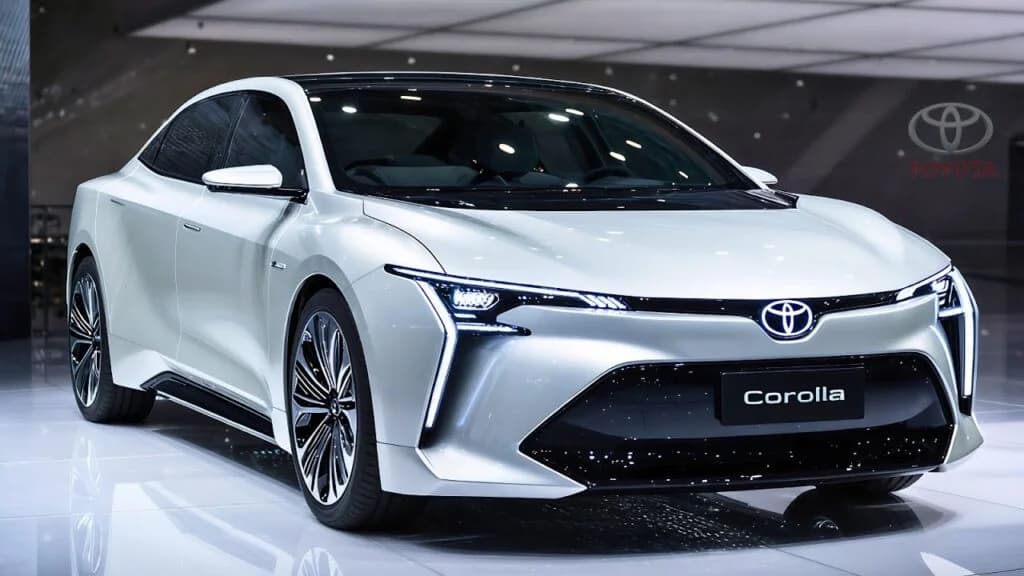
Every Toyota Corolla ever sold carries a 17-character code that tells you more than a dealer sticker ever will: where the car was actually built, what engine sits under the hood, and whether the number on the title even matches the car in the driveway. In 2025, Toyota sold 248,088 Corollas in the U.S. — a 6.5% jump that made it one of the only compact sedans to grow while the rest of the segment cooled (AutoGuide, retrieved September 2026). With that many Corollas changing hands, knowing how to read a VIN is one of the fastest ways to confirm a listing is telling the truth before you hand over a deposit.
This guide breaks a Corolla VIN down position by position, using a real, verified Corolla VIN as a working example throughout. If you just want the answer for one specific car, run it through our free Corolla VIN decoder tool and use this guide to understand what the results actually mean.
Key Takeaways
- A Corolla VIN has 17 characters split into three sections: World Manufacturer Identifier (positions 1–3), Vehicle Descriptor Section (4–9), and Vehicle Identifier Section (10–17).
- The 3-character WMI tells you the factory: JT2/JTD/JTE point to Japan, 1NX points to Fremont, California (historical), 2T1 points to Cambridge, Ontario, and 5YF points to Blue Springs, Mississippi.
- Position 10 is the model-year letter (L = 2020 through T = 2026); position 9 is a math-based check digit that catches typos and forged VINs.
- An estimated 2.45 million U.S. vehicles were on the road with a suspected rolled-back odometer in 2025, up 14% year over year (CARFAX, retrieved September 2026) — a decoded, cross-checked VIN is cheap insurance against buying one.
What a VIN Actually Tells You
A Vehicle Identification Number is a 17-character code assigned to every road-legal vehicle built since 1981, standardized under ISO 3779 and the U.S. federal standard 49 CFR 565. The letters I, O, and Q are never used, since they're too easily mistaken for 1, 0, and 9. Every character has a defined job — there's no encryption and no secret key, just a fixed structure that Toyota (and every other manufacturer) files with regulators.
That structure matters more than it sounds like it should. Odometer fraud alone affected an estimated 2.45 million vehicles on U.S. roads in 2025, a 14% jump from the year before, and buyers who unknowingly purchased a rolled-back car lost an average of roughly $3,300 in value (CARFAX, retrieved September 2026). Title washing — moving a salvage or flood-damaged car through a state with looser disclosure rules to strip the branding off its title — compounds the problem. A VIN decode won't catch everything, but it's the first, free check that flags whether a car's paperwork lines up with the car itself.
New to VIN decoding entirely? Start with what a VIN is and why it matters.
Where to Find the VIN on a Corolla
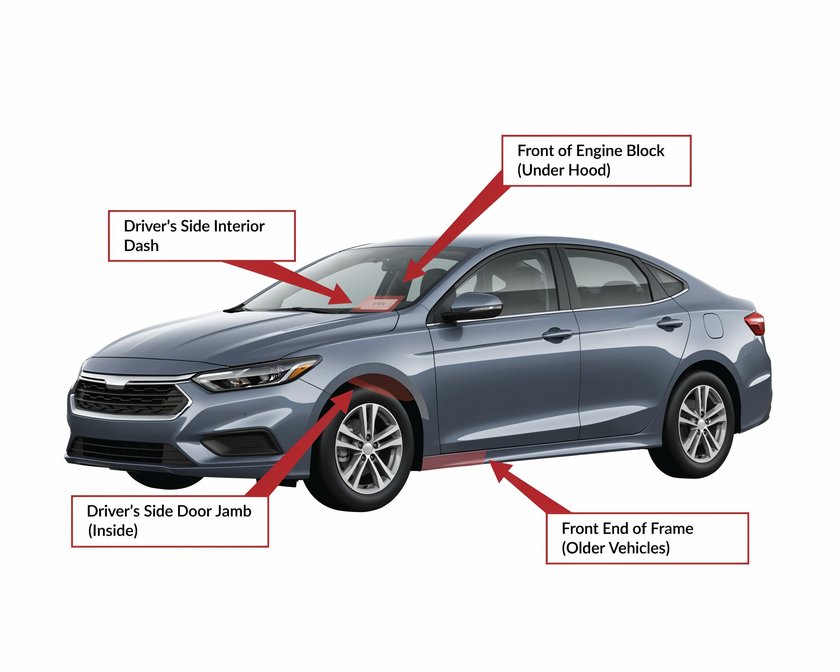
Before decoding anything, confirm you're reading the actual VIN and not a different code stamped elsewhere on the car:
- Dashboard — visible through the base of the windshield on the driver's side. This is the most reliable spot and the one dealers photograph for listings.
- Driver's door jamb — a sticker on the frame, visible when the door is open, usually paired with tire pressure and paint code info.
- Title and registration — the VIN printed on the state-issued paperwork.
- Insurance card or policy documents.
- Engine block — stamped near the front of the engine on most Corolla generations, though this requires popping the hood.
If any of these don't match exactly — not even by one character — treat it as a red flag and dig further before buying.
The 3 Sections of a Corolla VIN
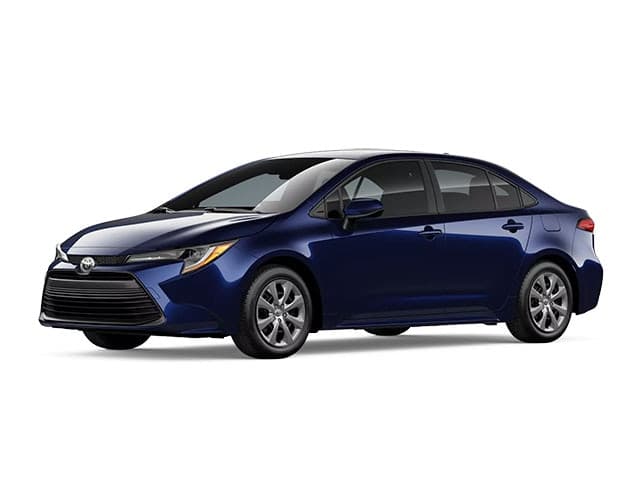
Every 17-character VIN breaks into three fixed sections. Here's what that looks like using a real, NHTSA-verified 2019 Corolla VIN as the example:
| Section | Positions | What it encodes |
|---|---|---|
| WMI | 1–3 | Country of origin and manufacturer |
| VDS | 4–8 | Model, body style, engine, restraint system (manufacturer-specific) |
| VDS | 9 | Check digit — validates the other 16 characters |
| VIS | 10 | Model year |
| VIS | 11 | Assembly plant |
| VIS | 12–17 | Unique production sequence number |
Positions 1–3: Which Factory Built Your Corolla
The World Manufacturer Identifier is the most useful part of the VIN for a quick sanity check, because it tells you the plant a Corolla actually rolled off of — useful for confirming a "Japanese import" claim or a rebuilt-title car's real origin.
| WMI | Manufacturer | Location | Corolla model years |
|---|---|---|---|
| JT2 | Toyota Motor Corporation | Toyota City, Aichi, Japan | 1981, 1984–1996 |
| 1NX | New United Motor Manufacturing (NUMMI) | Fremont, California, USA | 1988–2010 |
| 2T1 | Toyota Motor Manufacturing Canada | Cambridge, Ontario, Canada | 1990–2019, 2023 |
| 5YF | Toyota Motor Manufacturing Mississippi | Blue Springs, Mississippi, USA | Current U.S.-built Corollas |
| JTD / JTE | Toyota Motor Corporation | Japan | Japan-built Corolla variants |
A word of caution: manufacturers reassign and reuse WMI codes across decades and model lines, so a WMI alone can't confirm the exact trim or generation — it narrows things down. Cross-checking it against positions 4–11 (or running the full VIN through a decoder) is what actually confirms the vehicle.
See how Toyota's manufacturer codes work across the full lineup.
Positions 4–8: Model, Body, and Engine
This block is called the Vehicle Descriptor Section, and it's where Toyota encodes the specifics — but unlike the WMI, there's no single public master key. Each manufacturer registers its own scheme with regulators, and Toyota reuses the same letters across completely different model lines and generations. On a Corolla VIN, the rough breakdown looks like this:
| Position | What it generally encodes |
|---|---|
| 4 | Body type (e.g., sedan, hatchback) |
| 5 | Engine type |
| 6 | Series / trim family |
| 7 | Restraint system / additional model data |
| 8 | Model or platform code |
A few Corolla-relevant examples from Toyota's engine-code scheme: the letter R has appeared for the 1ZZ-FE 1.8L engine used in the early-2000s North American Corolla, N has covered the 2ZR-FXE hybrid engine used in the Corolla Hybrid, and V has covered the 1NR-FE 1.3L engine used in export-market Corolla Axio models (autoevolution, retrieved September 2026). At position 8, the letter E commonly denotes a Corolla or Matrix, though the same letter set gets recycled for other nameplates in other years — the letter R, for instance, has meant both "4Runner" and "Corolla" depending on the generation. That overlap is exactly why a position-by-position guide can only get you so far; a full decode against Toyota's registered VIN map is what removes the ambiguity.
For the current-generation (E210) Corolla, the two headline engines are the naturally aspirated 2.0L M20A-FKS (gas models) and the 1.8L 2ZR-FXE hybrid system, with the high-performance GR Corolla using a turbocharged 1.6L three-cylinder G16E-GTS producing up to roughly 300 horsepower.
Because these codes overlap across nameplates, don't assume a VDS letter in isolation — verify engine and trim against the full decode before relying on it for a purchase decision.
Position 9: The Check Digit (How to Catch a Fake or Mistyped VIN)
Position 9 isn't descriptive — it's a mathematically calculated validation character required under FMVSS 115 and ISO 3779. It exists purely to catch typos, forged plates, and cloned VINs.
The calculation has three steps:
- Transliterate every letter to a number (A–H = 1–8, J–N = 1–5, P = 7, R = 9, S–Z = 2–9, skipping repeats), while digits keep their own value.
- Multiply each of the 17 positions by a fixed weight (8, 7, 6, 5, 4, 3, 2, 10, 0, 9, 8, 7, 6, 5, 4, 3, 2 — note position 9 itself carries a weight of 0, since it's the value being solved for).
- Sum all 17 products and divide by 11. The remainder is the check digit — unless the remainder is 10, in which case the check digit is the letter X.
Using the same example VIN, 5YFBURHEXKP927002: running the calculation produces a total of 439, and 439 ÷ 11 leaves a remainder of 10 — which correctly maps to the check digit X that actually appears at position 9. If a seller's VIN produces a different check digit than the one printed, one of two things happened: someone mistyped it, or the VIN was altered. Either way, it's worth resolving before you go further.
Position 10: Model Year
Position 10 uses a repeating letter-and-digit cycle that resets every 30 years. For Corollas currently on the road, the relevant span looks like this:
| Code | Model year | Code | Model year |
|---|---|---|---|
| L | 2020 | P | 2023 |
| M | 2021 | R | 2024 |
| N | 2022 | S | 2025 |
| T | 2026 |
The letters I, O, Q, U, and Z, along with the digit 0, are skipped throughout the cycle to avoid confusion with other characters.
Positions 11–17: Assembly Plant and Production Serial
Position 11 identifies the specific assembly line within the plant already narrowed down by the WMI — in the example VIN, the letter P corresponds to Blue Springs, Mississippi (NHTSA vPIC, retrieved September 2026). The final six characters, positions 12 through 17, form the production sequence number: a simple running count that makes each individual Corolla's VIN unique, even among identical trims built the same day at the same plant.
Corolla Generations at a Glance
| Generation | Model code | Years | Notable engines |
|---|---|---|---|
| E140/E150 | — | 2006–2013 | 1ZZ-FE, 2ZR-FE |
| E160 | NRE160 / NZE161 | 2012–2019 (Axio/Fielder) | 1NR-FE, 1NZ-FE, 2ZR-FE |
| E170 | — | 2013–2019 | 1ZR-FE, 1NR-FE |
| E210 | — | 2018–present | M20A-FKS, 2ZR-FXE (hybrid) |
| GR Corolla | GZEA14 | 2022–present | G16E-GTS (1.6L turbo) |
Even as the Corolla ages, it's still winning against fresher rivals: Toyota's 2025 U.S. sales came in ahead of the Honda Civic for the first time in a few years.

One more current-year detail worth flagging: North American GR Corolla production shifted to Toyota's Burnaston, England plant in 2026, with the first UK-built units arriving in the U.S. in May 2026 — so newer GR Corollas will carry a different WMI than earlier Japan-built examples.
How to Use a Decoded VIN to Avoid a Bad Purchase
A decode is only useful if you act on what it tells you:
- Match the VIN in all four locations — dash, door jamb, title, and insurance card. Any mismatch is a stop-and-investigate moment.
- Verify the check digit using the steps above, or a decoder that does it automatically.
- Confirm the model year matches the listing. A seller advertising a "2024" Corolla with a VIN that decodes to model year 2023 is either mistaken or hiding something.
- Check for open recalls using the VIN against NHTSA's recall lookup — a free, official source.
- Pull a full vehicle history report for title branding, odometer discrepancies, and prior state registrations, since a VIN decode alone won't surface title-washing across state lines.
Run a full Corolla history report to cover everything a decode alone can't.
Reading a VIN by hand is a good habit, but it has limits — Toyota's own codes overlap across models and decades, which is exactly the kind of ambiguity a full database lookup resolves in seconds. Paste any Corolla's VIN into our free decoder to get the confirmed year, trim, plant, and open-recall status in one pass.
Decode Your Toyota Corolla VIN Free
Instant results. No signup required.
Pull the real history behind any car — recalls, title brands, odometer trail.
Our Services
Generate and print an authentic window sticker for any Toyota vehicle using its VIN.
Obtain a comprehensive factory build sheet detailing all specifications for any Toyota using its VIN.
Access unlimited vehicle history reports and detailed information for Toyota dealerships.
Find the exact paint code and color details for a Toyota by VIN.
Look up factory-installed options and packages for any Toyota by VIN.
Check the warranty status and coverage details of a Toyota by VIN.
Retrieve detailed specifications, including engine, transmission, and dimensions, for any Toyota by VIN.
Frequently Asked Questions
The most reliable spot is the dashboard, visible through the base of the windshield on the driver's side. It's also stamped on a sticker inside the driver's door jamb and printed on the title, registration, and insurance card.
It's the model-year code. For Corollas built in the last several years, L = 2020, M = 2021, N = 2022, P = 2023, R = 2024, S = 2025, and T = 2026.
Recalculate the check digit at position 9 using the VIN's other 16 characters. If it doesn't match what's printed, the VIN has either been mistyped somewhere or altered. Also confirm the VIN is identical across the dashboard, door jamb, and title — cloned VINs are copied from a different, legitimately registered vehicle, so title and location details sometimes don't add up on closer inspection.
No. The first three characters depend on where the car was built. Historical and current Corollas have used JT2 and JTD/JTE (Japan), 1NX (Fremont, California — discontinued), 2T1 (Cambridge, Ontario), and 5YF (Blue Springs, Mississippi), among others.
Yes. NHTSA's vPIC database is free and authoritative for basic specs, and dedicated tools like our Corolla VIN decoder add plant, generation, and history-report context on top of it.
Related Guides
Where Are Toyota Tundras Made? Tundra Manufacturing Locations | Toyota Vin Decoder
Find out where Toyota Tundras are made. Learn about the Tundra's manufacturing plants, production history, and its American-made roots. Get your VIN report now!
What Does LE Stand For Toyota? Trim Level Guide & VIN Decoder
Uncover the meaning of Toyota LE trim levels. Discover features, compare trims, and decode your VIN. Learn about SE, XLE, and more. Get the details here!
Toyota Transmission Fluid Change: Timing, Cost & Instructions
Need to change your Toyota transmission fluid? Find out how often, what it costs, and how to do it. Get the best advice and keep your Toyota running smoothly.
Grinding Noise When Accelerating: Causes & Solutions | Toyota VIN Decoder
Experiencing a grinding noise when accelerating? This guide explains common causes like wheel bearings, brakes, and more. Get expert advice and solutions for your car.
Bank 1 Sensor 2 Upstream or Downstream? Location & Function
Demystifying Bank 1 Sensor 2. Is it upstream or downstream? Find out the exact location, what it does, and how to troubleshoot problems. Get insights and resources for your Toyota at ToyotaVinDecoder.com.

Modded Toyota Camry: Customization, Mods, and Styling Guide
Discover the best modded Toyota Camry ideas! Learn about performance upgrades, styling, and customization. Find inspiration for your own Camry mods.
Decode Your Toyota VIN Free
Get instant results. No signup required.